
 Artificial intelligence is no longer a futuristic concept. It’s now deeply embedded in how modern software is built, deployed, and scaled. From automation tools to low-code platforms, AI is reshaping development workflows at every level.
In 2026, the shift is clear: companies are moving faster, building smarter, and relying more heavily on AI-powered systems to stay competitive. Whether you're a developer, founder, or product manager, understanding the latest AI software development statistics gives you a serious edge.
If you're exploring AI tools and platforms driving this shift, you might want to check out our dedicated guide on the best AI development platforms 2026.
The Rise of AI in Software Development
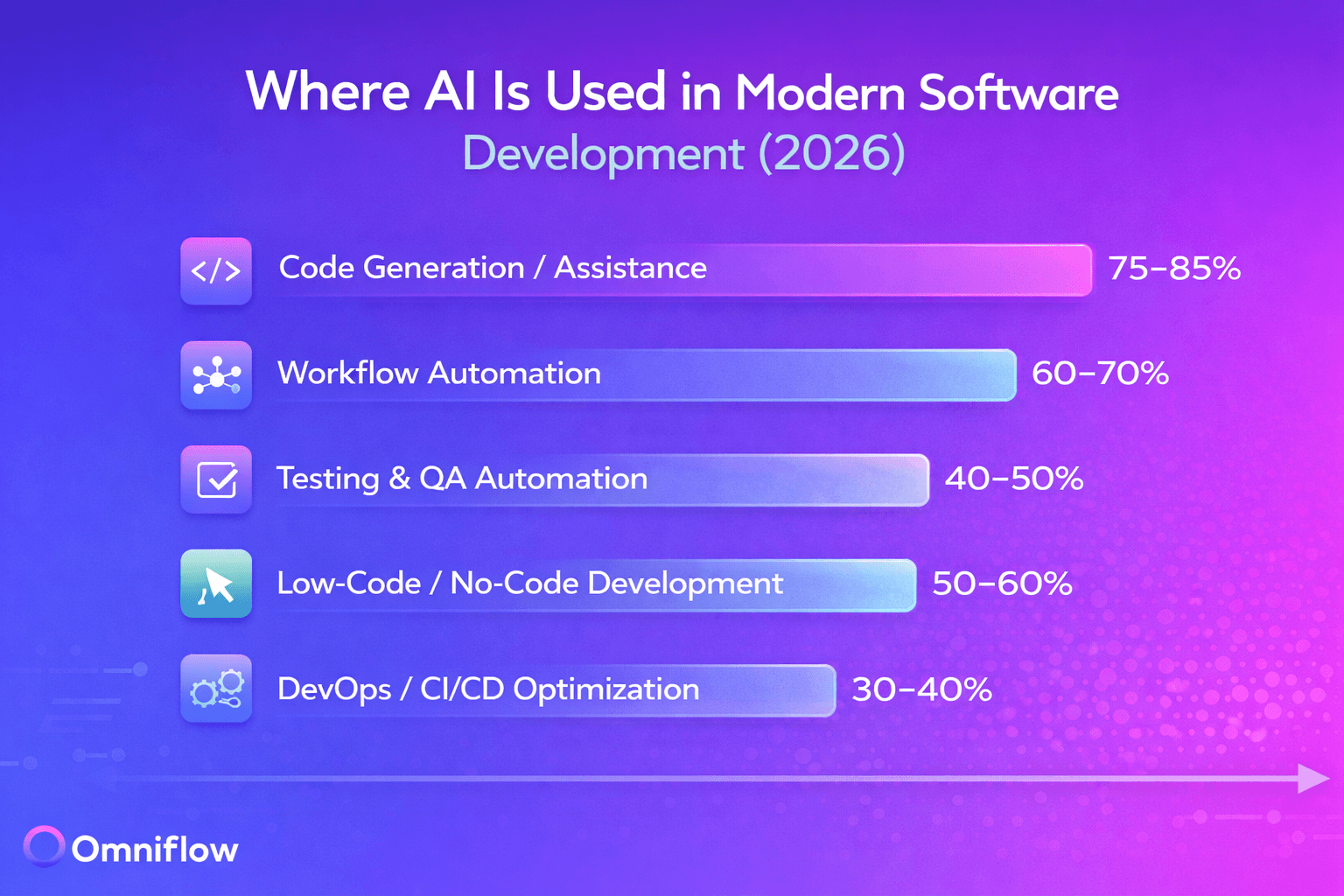
AI is fundamentally changing how software is created. Instead of writing every line of code manually, developers are increasingly relying on AI-assisted tools to generate, test, and optimize code. Recent studies show that over 80% of software developers now use AI tools in some part of their workflow, whether for debugging, code suggestions, or automation.
Moreover, AI tools like Copilot are estimated increase developer productivity by as much as 94%. And workflow automation tools like Omniflow can cut product development process times down by as much as 70% from start to finish. Overall, this aligns with broader trends in AI adoption across industries, which we break down further in our blog post on AI usage statistics.
Business Automation Statistics - How Artificial Intelligence Is Reshaping The Business World
One of the biggest drivers behind AI software development is business automation. Companies are no longer building software just to support operations. They’re building systems that replace manual work entirely.
According to McKinsey Global Institute, approximately 60% of occupations have at least 30% of tasks that can be automated. Additionally, businesses that adopt automation report up to 40% increases in productivity. This explains why automation-first platforms are exploding in popularity. Companies are investing heavily in tools that reduce repetitive tasks and streamline operations.
If you're building automation into your own tools, this ties directly into custom solutions like custom business software.
 Digital Transformation Statistics - The Impact On Developers Worldwide
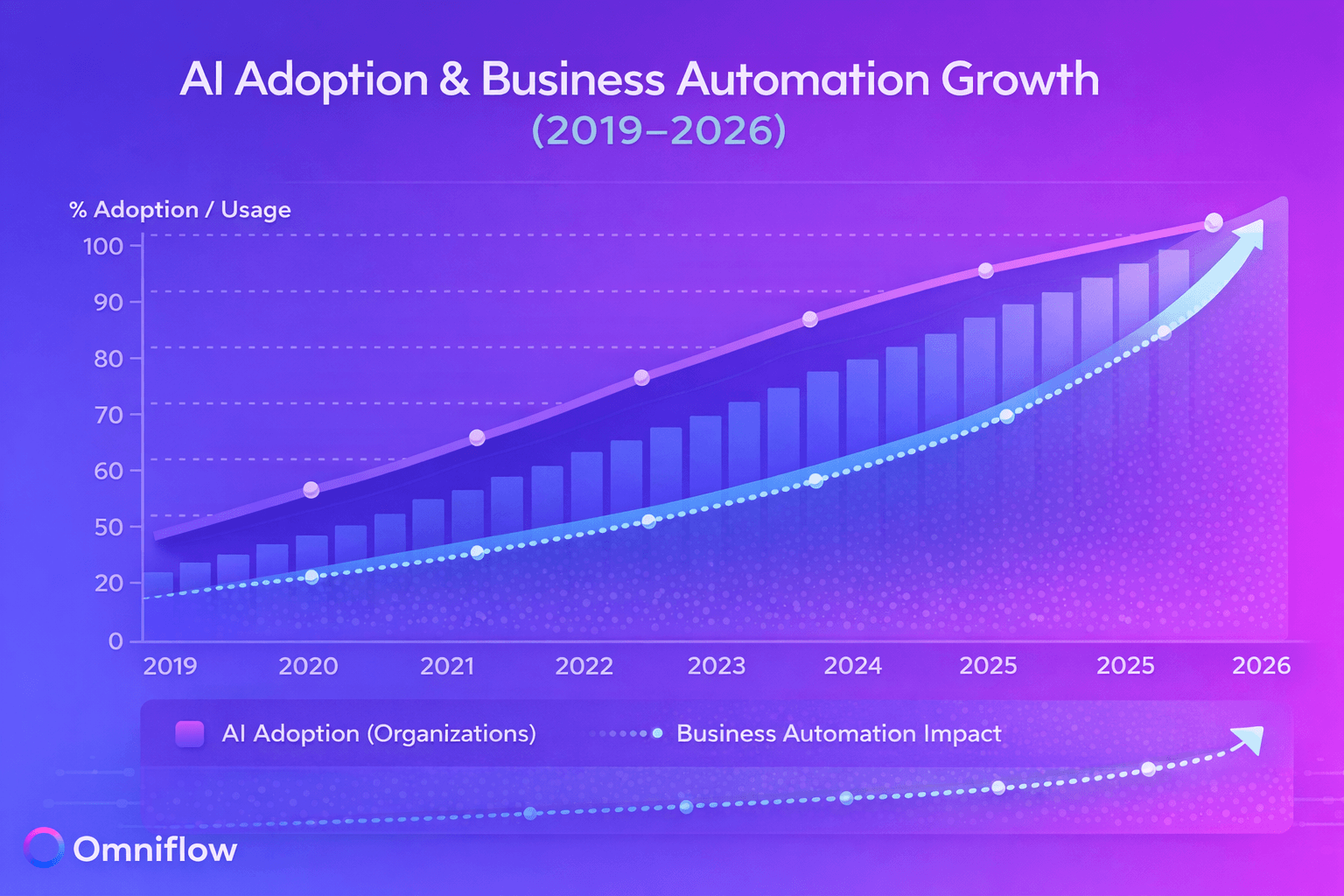
AI isn’t just improving software. It’s driving full-scale digital transformation across industries. For example, today, it's estimated that over 70% of organizations have a digital transformation strategy in place. And, companies that prioritize digital transformation are thought to be as much as 26% more profitable than peers.
No matter how you look at it, whether you think AI is replacing software development engineers or not, the fact is that AI plays a central role in this shift by enabling smarter decision-making, predictive analytics, and scalable infrastructure. This transformation is especially visible in how AI is integrated into apps and business systems.
If you’re looking to implement this yourself, here’s a practical guide on how to integrate AI into an app
How Omniflow Is Accelerating Digital Transformation
Omniflow is accelerating digital transformation by streamlining the entire product development lifecycle. From simplifying ideation with live, dynamic living PRDs to automating complex product workflows, it removes friction for founders, PMs, and product teams. With a full suite of AI-powered tools, Omniflow makes it faster and easier to turn ideas into real, functional products—bridging the gap between concept and execution.
Low-Code Development Statistics - Mobile App Development With AI Assistance & AI Generated Code
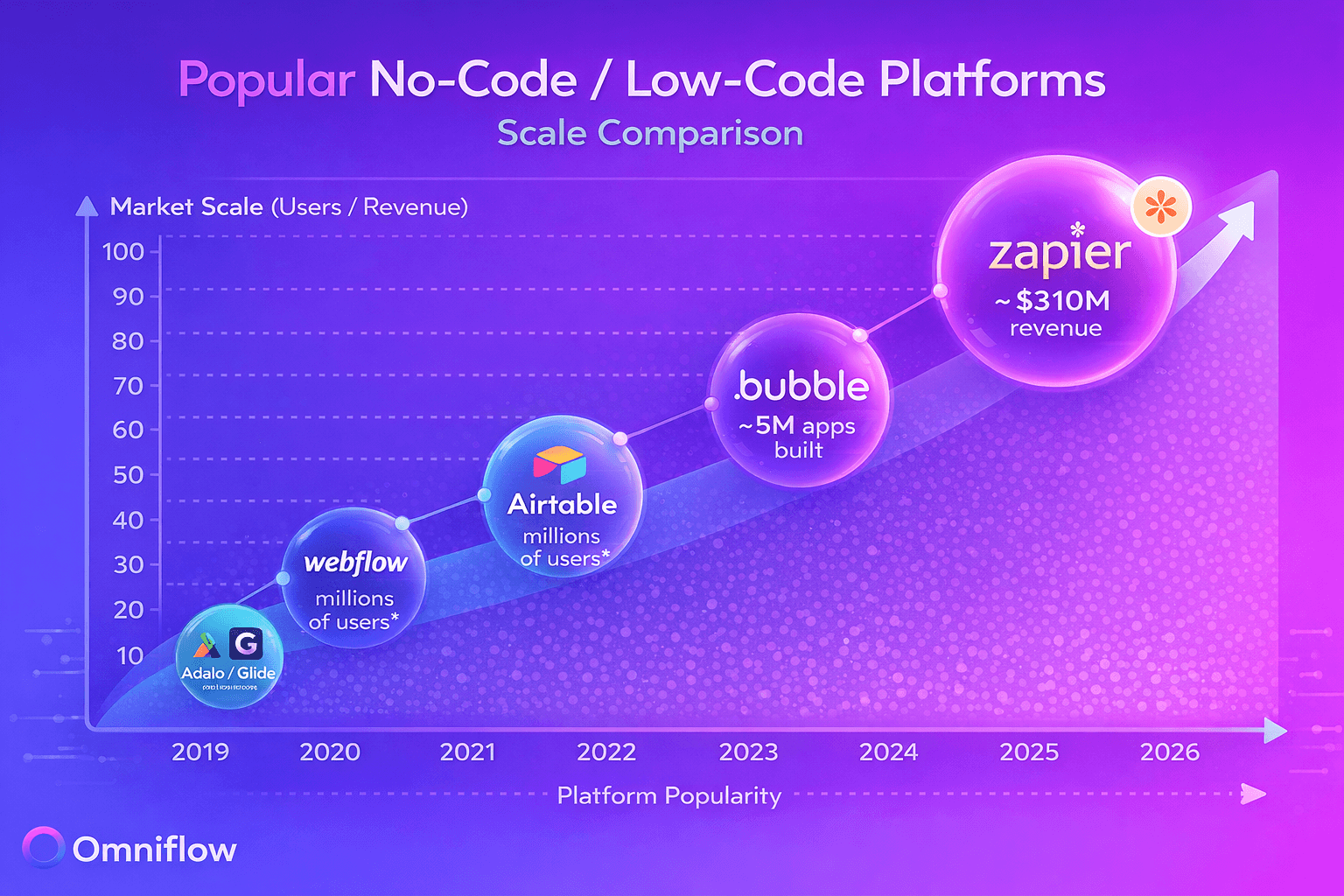
Low-code platforms like Lovable are one of the biggest beneficiaries of AI-driven development. By reducing the need for manual coding, they allow businesses to build applications faster and with fewer resources. Gartner forecasts the entire global low-code development technologies market to grow 23% in 2021. Additionally, it's believed that by 2026, over 75% of new applications will be developed using low-code or no-code technologies.
But why is the market expected to grow by so much? Ultimately, it's because low-code development can reduce app delivery time by up to 90%. AI enhances these platforms by generating logic, workflows, and integrations automatically, turning non-developers into builders. This shift is democratizing software creation, making it accessible to teams that previously relied entirely on engineers.
No-Code Development Statistics - AI's Impact For Non-Technical Founders
No-code development takes things even further by eliminating programming entirely. AI plays a massive role here by interpreting natural language inputs and turning them into functional applications. The global no-code market is expected to reach $45 billion+ by 2027. Meanwhile, nearly 65% of application development will be done outside traditional IT departments
This trend is reshaping who can build software. Entrepreneurs, marketers, and operations teams are now launching apps without writing code. AI assistants like OpenClaw, (learn more here: What is Clawdbot?) are accelerating this even further.
 Workflow Automation Statistics - Improving The Development Process
Workflow automation is where advanced AI software development delivers immediate, tangible ROI.
We've already highlighter how much time AI can solve when designing PRDs, creating MVPs and working prototype, or deploying live products. But what's more is that, by automating and improving decision-making, AI-driven workflows can reduce human error by up to 90%. From customer onboarding to internal operations, AI-powered workflows are replacing manual processes at scale.
This ties closely into workplace adoption trends, which we explore more in our AI in the workplace statistics.
Why AI Software Development Statistics Matter
When you step back and look at the data, a few key themes emerge:
AI is accelerating development speed dramatically
Automation is becoming the default, not the exception
Non-developers are increasingly building software
Businesses that adopt AI are gaining a measurable competitive edge
The biggest takeaway? AI is no longer just a tool. It’s becoming the foundation of modern software development. Companies that fail to adopt AI-driven workflows risk falling behind competitors who can build faster, iterate quicker, and operate more efficiently.
Final Thoughts - The Rise Of AI Agents & Developer Tools
AI software development in 2026 is defined by speed, accessibility, and automation. What once required full engineering teams can now be accomplished by small, agile groups using AI-powered tools.
Whether you're building internal tools, customer-facing apps, or full-scale platforms, AI is fundamentally changing what's possible. The opportunity isn’t just in using AI. It’s in understanding how these trends connect and where they’re heading next.
Have an idea sitting in your notes? Bring it to life with Omniflow’s AI-powered tools. Start building your today. Sign up and try Omniflow for FREE!
 FAQs - AI Software Development Statistics
What percentage of developers regularly use AI tools?
Over 80% of professional developers now use AI tools in some part of their workflow, including code generation, debugging, and automation.
How big is the no-code and low-code market?
The no-code market is projected to exceed $45 billion by 2027, while over 75% of applications will be built using low-code or no-code tools.
Does AI actually improve productivity in software development?
Yes. AI and automation can increase productivity by up to 40% and significantly reduce development time.
What industries benefit most from AI software development?
Industries undergoing digital transformation, such as finance, healthcare, and SaaS technology companies, see the biggest gains from AI-driven development.
Is AI replacing developers?
Not exactly. AI is augmenting developers by automating repetitive tasks, allowing them to focus on higher-level problem-solving and architecture.
How can I start building AI-powered applications?
Start by exploring modern platforms and frameworks, and follow a structured approach like this guide on how to integrate AI into an app.
Sources & References
GitHub. (n.d.). GitHub Copilot: Your AI pair programmer. https://github.com/features/copilot
McKinsey Global Institute. (2017). A future that works: Automation, employment, and productivity. https://www.mckinsey.com/capabilities/operations/our-insights/a-future-that-works-automation-employment-and-productivity
Gartner. (2021). Gartner forecasts worldwide low-code development technologies market to grow 23% in 2021. https://www.gartner.com/en/newsroom/press-releases/2021-02-15-gartner-forecasts-worldwide-low-code-development-technologies-market-to-grow-23-percent-in-2021
GlobeNewswire. (2022). No-code development platform market size to reach $45.5 billion by 2027. https://www.globenewswire.com/en/news-release/2022/03/23/2408460/0/en/No-Code-Development-Platform-Market-Size-to-Reach-45-5-Billion-by-2027.html
Forrester. (n.d.). The total economic impact™ of automation. https://www.forrester.com/report/the-total-economic-impact-of-automation/