The Best No-Code App Builders & Why Omniflow Is Leading the Next Generation of Continuous Product Creation
 The rise of no-code and low-code app builders has transformed how businesses, entrepreneurs, and teams build software.
What once required months of development and large engineering teams can now be accomplished in weeks or even days using visual tools and automation.
From startups launching MVPs to enterprises modernizing internal tools, no-code platforms have become essential. They reduce costs, accelerate development, and allow non-technical users to participate in building products.
However, as companies scale, many discover that traditional no-code tools struggle with performance, customization, collaboration, and long-term maintainability.
This is where modern AI-powered product creation platforms like Omniflow are redefining what “no-code” can truly mean.
While Omniflow is not a no-code app builder, this article will help you understand what the best no-code app builders are, and how Omniflow stands out as the best AI product agent for full-scale, scalable development.
Bubble
Bubble is one of the most established players in the no-code ecosystem. It allows users to build web applications with advanced workflows and databases.
Some of its strengths include it being a powerful visual logic builder, having a large community and plugin ecosystem, and being highly customizable.
However, we feel Bubble is limited due to a steeper learning curve compared to similar platforms, performance challenges at scale, and because, in our experience, it can become complex for large teams to use.
The way we see it: Bubble is excellent for advanced solo builders and startups, but managing large projects and optimizing performance often requires deep platform expertise.
Glide
Glide focuses on transforming spreadsheets into functional mobile and web apps.
Some it this no-code platform's strengths include it being extremely easy to use, even for beginners, and that it's quick and easy setup, which makes it ideal for building internal tools.
However, we feel users are relatively limited when it comes to customization. It's also not really designed for complex products, which means that scaling can feel restrictive
In our opinion, Glide works best for lightweight applications but is not intended for full-featured commercial platforms.
Adalo
Unlike some of the other competitors here, Adalo specializes in mobile-first no-code development.
It's strengths include offering mobile-friendly UI designs, having a drag-and-drop interface, and that it supports App store publishing.
On the other hand, we've also experienced performance issues when working on larger apps, limited backend flexibility, and scaling challenges.
We believe that Adalo is great for simple mobile apps. But growing products often outgrow its infrastructure, requiring teams to look for other alternatives.
 FlutterFlow
FlutterFlow blends low-code development with Flutter-based outputs.
It's a strong platform if you're looking for something that produces native code, offers strong UI control and that's developer-friendly.
But we feel that using FlutterFlow requires technical knowledge, which makes it less accessible for non-developers due to that higher level of complexity.
For more experience developers and teams, FlutterFlow may be appealing. But it still requires coding experience to fully leverage its power.
Softr
Softr is designed for building client portals and internal tools on top of Airtable and databases.
Some of its strengths include it being simple to setup, offering clean templates, and being effective for building internal portals and dashboards.
That said, Softr is limited when it comes to custom logic. It also has a reliance on external databases, which leads us to believe that it's not really built for complex products.
Our opinion is that Softr works well for business tools but lacks depth for full-scale software platforms.
Clawdbot
Clawdbot, while not technically a no-code app builder, focuses on automation and AI-assisted workflows.
It offers a wide range of automation capabilities, local AI-powered processes, and customizable workflow optimization.
However, Clawdbot is limited as a full-app development tool, which means it's better suited for personal use compared to larger product development.
Clawdbot excels in personal automation and AI assistance, but is not designed as a complete application development system.
Base44
Base44 emphasizes database-driven app creation.
It offers strong data management, structured workflows, and reliable performance.
But we've found that it offers less flexibility in terms of design, has a smaller ecosystem, and limited AI integrations.
If you ask us, Base44 suits data-heavy applications but may feel restrictive for creative or product-focused teams.
Lovable
Lovable is one of the most popular AI agent out there today. It uses AI to help users generate app components and interfaces for a wide range of applications.
Its strengths include AI-assisted app creation, fast prototyping, and being beginner-friendly.
However, in our opinion, it's an early-stage platform with limited enterprise features.
Lovable is promising for rapid experimentation but not truly ideal for large-scale application deployments.
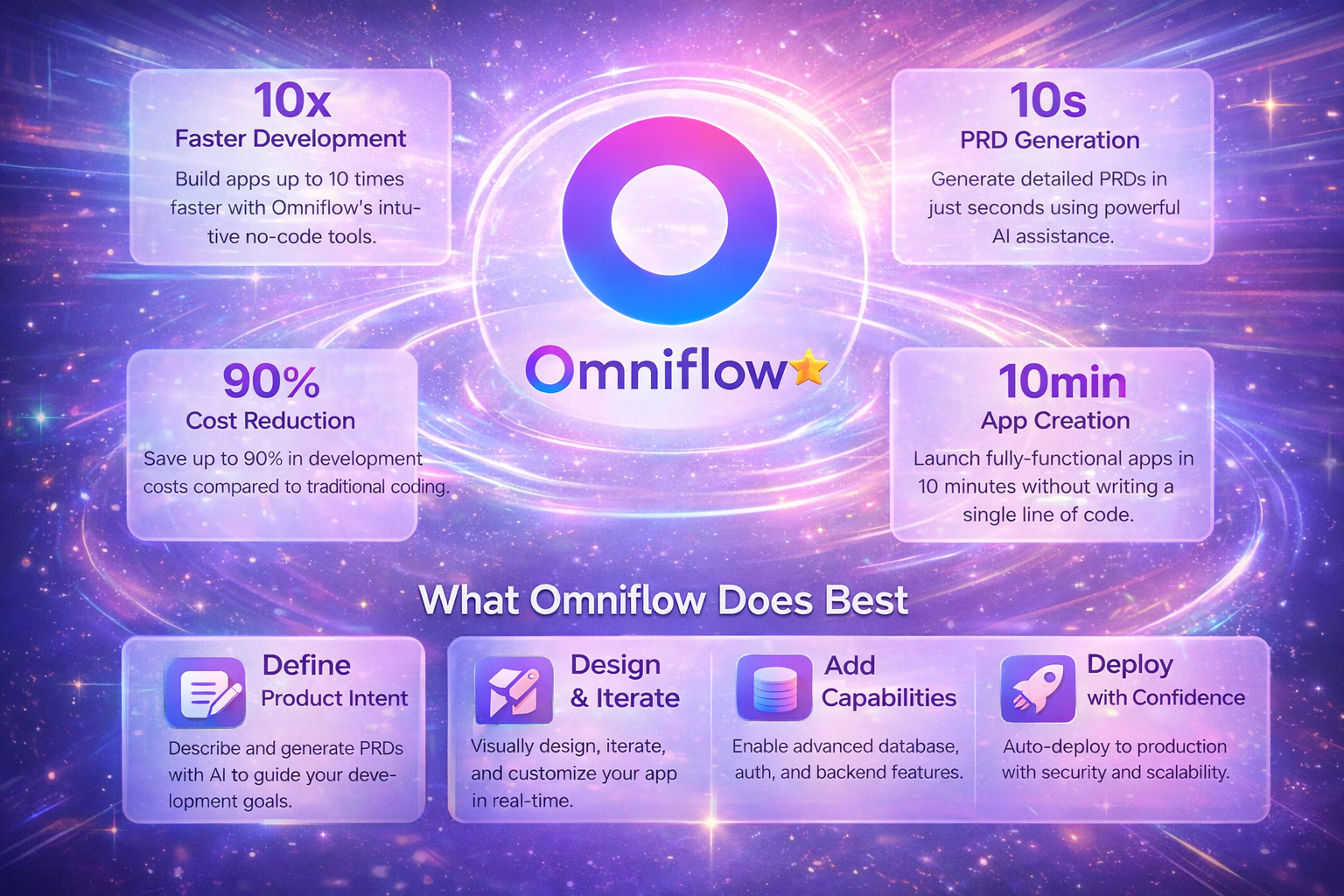 Why Omniflow Is the Best Continuous Product Creation Platform
While each of the platforms discussed above offers valuable tools, most were designed for either individual creators or small custom app projects.
As products grow, teams often encounter limitations in performance, collaboration, governance, and customization. Omniflow addresses these challenges by functioning as an AI-powered continuous product creation platform rather than just a visual-based no-code app builder.
Here's a closer look at what makes Omniflow one of the best options out there for teams that need a scalable solution.
AI-Driven Product Architecture
Omniflow doesn’t just assemble components. It helps design scalable systems.
Its AI can analyze business requirements thanks to its Knowledge Base feature, recommends optimized architectures, UI designs and wireframes, workflows, and integrations, and supports living product requirement documents that auto-sync throughout the entire development process.
This reduces technical debt and ensures long-term stability.
Built for Team Collaboration
Unlike no-code tools built for solo users, Omniflow is designed for teams. Some of collaboration features include:
Role-based permissions
Review and approval systems
This makes it ideal for startups, agencies, and enterprises.
Enterprise-Grade Scalability
Omniflow supports high-performance infrastructure, scalable databases, cloud-native deployment, and other advanced security features that make it ideal not just for solo users and small-time developers, but also for full-scale businesses and enterprises that need the best of the best.
With Omniflow, teams can grow without rebuilding their product from scratch.
End-to-End Product Management
Omniflow supports the entire lifecycle:
Idea validation
Prototyping
Development
Testing
Deployment
Optimization
This unified approach reduces tool sprawl and accelerates delivery. And these are only a few of the key features that make Omniflow better than the many no-code app builders you'll find out there on the market today.
Omniflow is also a constant work in progress.
We're always adding new features and improving our platform to make sure it meets the needs to today's modern product managers, developers, software engineers, app creators and anyone else who wants to build complex progressive web apps at scale.
 The Best No-Code App Builder Vs. Omniflow's Continuous Product Creation Platform - Final Verdict
If you’re building simple apps or internal tools, platforms like Glide, Softr, or Adalo may be sufficient.
However, app building isn't always simple or straightforward. So, for businesses or teams building serious, scalable, production-ready applications, Omniflow stands out as one of the best options available.
Whether you're looking for the best app builder to write simple, custom code or the most comprehensive product creation platform to help your team tackle apps with complex logic and that need to integrate other apps, Omniflow's AI can help you easily incorporate all the features, APIs and other tools you'll need right from the start.
Omniflow's AI product agent approach bridges the gap between rapid development and enterprise-grade engineering, which, if you ask us, makes it an ideal product creation tool for long-term success.
Frequently Asked Questions (FAQs)
Which is the best app maker without coding?
Omniflow is not a no-code app builder. However, for full-scale, team-based development, it is one of the most advanced product creation platforms available. Omniflow combines AI, scalability, and collaboration tools in one platform.
What is the most effective no-code website builder?
For simple websites, tools like Softr and Glide are effective. For complex web platforms and applications, Omniflow provides more flexibility and long-term reliability.
What are the most popular no-code platforms?
Popular platforms for building Android apps and other simple native apps include Bubble, Glide, Adalo, FlutterFlow, Softr, Lovable, Base44, Clawdbot, and although it is not technically a no-code app builder, Omniflow is a continuous product creation platform that supports many of the same features as other no-code platforms.
Can no-code platforms replace traditional development?
For many applications, yes. Modern continuous product creation platforms like Omniflow enable teams to build complex systems without the need to write code manually from the start, and all while maintaining professional standards.
Is no-code suitable for startups and enterprises building scalable apps?
Yes. Startups benefit from faster MVP creation, while enterprises benefit from reduced costs and improved agility, especially when using scalable platforms like Omniflow.