Will software engineers be replaced by AI?
 Will software engineers be replaced by AI?
Whether you're an individual developer, team leader, product manager, or entrepreneur, you already know that artificial intelligence and generative AI are transforming traditional programming and software engineering roles.
AI tools like ChatGPT, Gemini, Lovable or Omniflow can understand programming languages such as Python, Java, and C++. They can also leverage natural language processing (NLP) to create entire web applications from scratch, without any manual coding whatsoever.
Which leaves many of us wondering: Will AI replace software engineers in the future?
Below, we explore the role of generative AI in today's development processes, the human skills required for software development, and ultimately, whether or not we think software engineers will be replaced by AI tools in the future.
Will AI replace software engineers?
In our opinion, AI will not replace software engineers any time soon, but it is already impacting engineers' roles in the development process.
Currently, artificial intelligence can generate code, but it still requires human software engineers to guide and oversee its accuracy.
AI is making it easier to write code and develop applications quickly. But, at least for now, humans are still needed for quality assurance, testing, etc.
So no, we don't think that AI will replace software engineers or programmers. But it will continue to affect their jobs, changing the way software is designed, built, tested, deployed, and monitored throughout the product lifecycle.
 What Is Generative AI And What Is Its Role In Product Development?
Generative AI is simply artificial intelligence that creates content such as text, images, videos, and code.
Therefore, this type of AI can automate programming tasks by generating code for both simple and more complex applications.
ChatGPT is one of the most popular AI platforms for generating code.
However, there are many other similar development tools, like Omniflow, which leverage AI to generate product requirements (PRDs), create rapid prototypes and MVPs, ship production-ready applications, and deploy them out into the world.
AI is being used to speed up planning, production, and development. But contemporary AI platforms are a long way from completely replacing the need for human software engineers and developers.
What Are The Human Skills Required For Software Development?
Human skills such as problem-solving, critical thinking, and creativity are essential in programming and product development. Empathy and communication are also critical human skills that go hand in hand with the technical skills required for software development.
Here are a handful of other skills that AI-powered machines aren't yet able to recreate:
Team collaboration
Adaptability
Creativity
Attention to detail
Machines are great at producing large amounts of content quickly. But current AI models lack the critical thinking needed to take an idea from seed to a full-scale product without at least some human input from software developers.
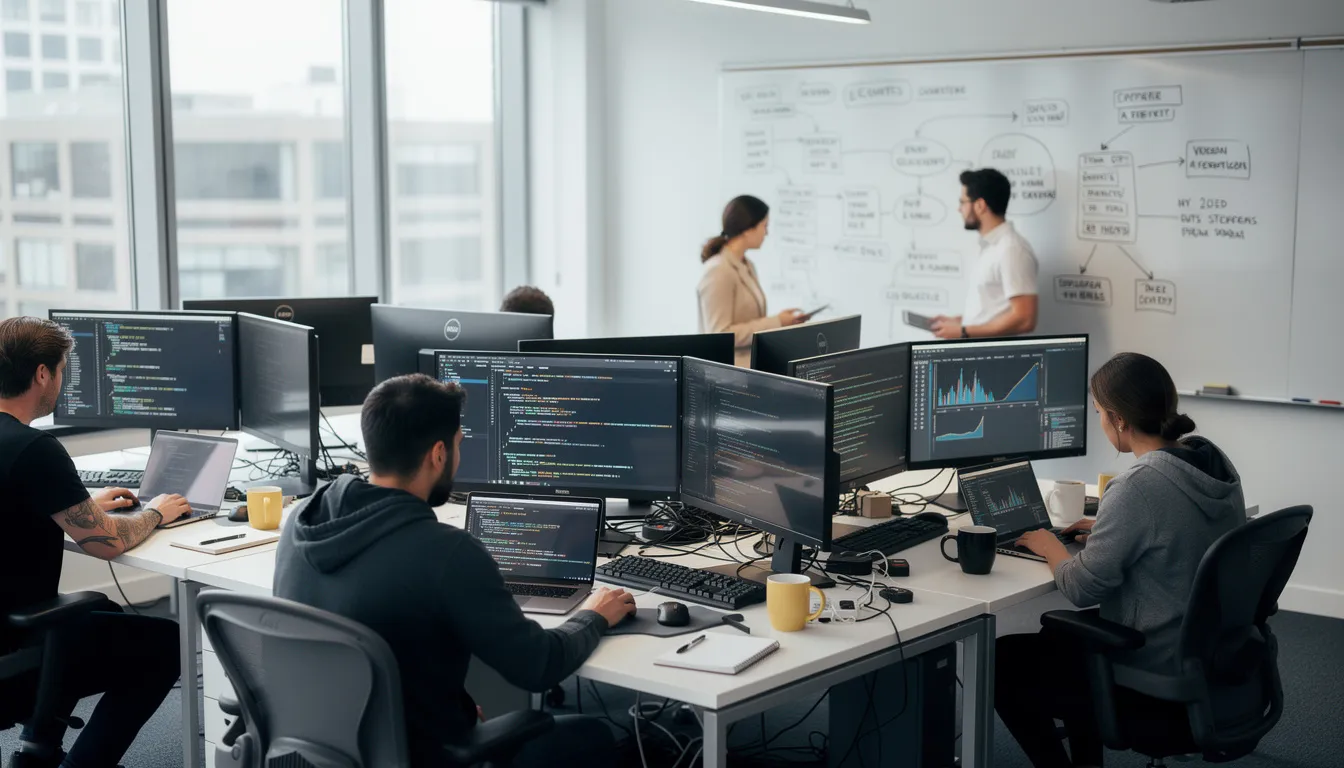 The Impact Of Artificial Intelligence On Developer Careers
While we don't believe AI is ready to replace software engineers any time soon, there's no doubt that AI tools are changing the software development industry as we know it.
No matter how you see it, AI is already replacing many basic, tedious, and time-consuming programming tasks, which opens the door to a range of ever-evolving computer science roles.
Advanced reasoning, ethics, and design thinking are increasingly important in computer science.
Therefore, we can only imagine that the future software development landscape will include computer science careers that are more interdisciplinary, intersecting somewhere between complete AI-powered development and traditional human creativity.
Software development methodologies may change. People will continue to use platforms like ChatGPT, Lovable, Omniflow, and other Vibe Code platforms to create products. But for now, human programmers are still an important part of the equation.
Ultimately, the growth of the AI industry and development of AI-powered development platforms creates more, not fewer, opportunities for skilled programmers, whose jobs may not always look the same, but that will still require a human touch to get right.
Evolving Roles in the Tech Industry, Computer Science, Bug Detection, And Data Structures
The role of computer scientists is shifting from coding to designing smarter, more ethical systems.
AI-generated code won't replace software engineers. But it will likely lead to new hybrid roles for building, managing, and optimizing the large-scale deployment of AI systems.
Here's a list of potential roles and careers that are becoming increasingly common as artificial intelligence and AI-generated code continue to change the industry.
 AI-Augmented Software Engineering
AI Pair-Programming Facilitator
Prompt/Model Interaction Engineer
AI Code Quality Strategist
AI-Accelerated Feature Prototyper
Legacy-to-AI Refactoring Specialist
Automated API Integration Architect
AI-Driven Deployment + Release Engineer
Computer Science & Systems Roles
Algorithm Adaptation Engineer (AI-optimized algorithms)
Hybrid ML + Traditional CS System Designer
Explainability-First Systems Developer
Data-centric Software Architect
Human-in-the-Loop System Engineer
AI-Driven Systems Performance Analyst
Computational Ethics / Risk Mitigation Engineer
Bug Detection + Code Reliability Roles
AI Bug Detection Specialist
Automated Patch/Repair Engineer
Static/Dynamic Analysis AI Trainer
Secure-by-AI Code Auditor
Synthetic Test Generation Engineer
Predictive Maintenance Engineer (software failure prediction)
Autonomous QA Pipeline Architect
Data Structures + Knowledge Engineering Roles
AI-Optimized Data Structure Designer
Vector/Embedding Space Architect
Real-Time Knowledge Graph Engineer
Hybrid symbolic + neural memory system developer
Retrieval-Augmentation Specialist (RAG workflows)
AI Memory + Storage Continuity Architect
Intelligent Caching/Indexing Engineer
Cross-Disciplinary + Emerging Hybrid Roles
AI Product Strategist for Engineering Tools
Human-AI Collaboration Researcher
AI Governance Lead for Software Teams
ML-Assisted DevOps Analyst
AI Workflow Orchestration Architect
Automated Documentation + Code Knowledge Engineer
 Future Proofing Your Career - How to make sure you're not replaced by AI
Continuous learning and adaptability are vital to stay relevant in AI-driven computer science. Curiosity and the ability to learn new skills will define future success.
Students should look at AI as a tool, not an obstacle. They should experiment with AI and build creative projects, even imperfect ones, to explore the possibilities of full-stack AI development.
If you ask us, embracing AI as a tool enhances career growth and innovation. It shouldn’t impede it.
Coding skills may become less relevant as machines write faster and more complex code. But those who focus on data science, software engineering, and machine learning, and who continually advance their skills, will have a better chance of making it in tomorrow's programming industry.
Conclusion - Will AI Replace Programmers?
AI won’t replace programmers or software engineers. But it will serve as a collaborative partner in future coding tasks, and it's bound to have a massive, yet-to-be-realized impact on the industry.
However, combining fundamental programming skills with AI knowledge can help prepare today's software developers for evolving industry trends. Mastering AI tools amplifies productivity and output, making it easier for developers to ship better products with far less work than in the past.
Regardless, the future of computer science involves integrating AI to enhance innovation and creativity. But as of right now, AI doesn't replace the need for humans.
FAQ Section
Will AI replace software engineers in the future?
AI will automate repetitive coding tasks and accelerate development, but full replacement is unlikely. Software engineering involves creativity, problem-solving, ethics, and collaboration, which are areas AI struggles with. Instead, AI will reshape the role, shifting their work toward architecture, oversight, strategy, integration, and the management of AI-generated code.
Which tech jobs can't AI replace?
AI struggles to replace roles that need abstract reasoning, interpersonal understanding, and accountability. Tech jobs resistant to automation include product strategy, UX research, cybersecurity leadership, ethical AI oversight, human-centered system design, enterprise architecture, and other roles requiring cross-disciplinary judgment.
Is AI the end of programming?
No. AI changes how programming is done rather than eliminating it. Low-level syntax writing may fade, but problem framing, debugging complex failures, system design, and performance tradeoffs remain human-driven. Human expertise will stay essential for directing intelligent automation.
Is it worth becoming a software engineer in 2026?
Yes. Demand for software engineers remains strong, especially those who learn to collaborate with AI. New opportunities are emerging in AI-assisted development, automation pipelines, system integration, security, and responsible AI. Future engineers who master AI tools will produce more value with less code, meaning the field evolving and not disappearing.