
 Artificial intelligence is rapidly transforming how software is built.
From enterprise machine learning infrastructure to AI-powered coding assistants and no-code builders, modern tools are making it easier than ever for developers, founders, and product teams to create AI-powered applications.
As a result, many teams are now searching for the best AI development platform to help them build, deploy, and scale intelligent products faster.
But the reality is that not all AI platforms serve the same purpose.
In this guide, we explore some of the best AI development platforms in 2026, what they’re used for, and highlight their key strengths and weaknesses.
What Is an AI Development Platform?
An AI development platform is a software environment that helps developers and product teams build, train, deploy, and manage artificial intelligence applications.
These platforms may include tools for machine learning model training, AI-assisted coding, automation workflows, or even full application generation.
Key Summary: Best AI Development Platforms in 2026
Below is a quick overview of the major AI development platforms covered in this guide.
Platform | Category | Best For |
|---|---|---|
Vertex AI (Google Cloud) | Enterprise AI Platform | Model training and deploying machine learning models at scale |
Azure Machine Learning | Enterprise AI Platform | Enterprise-grade ML pipelines and integrations |
Cursor | AI Coding IDE | AI-assisted software development |
GitHub Copilot | AI Coding Assistant | Writing code faster with AI agents |
Bubble | No-code builder | Building web apps without code |
Glide | No-code builder | Turning spreadsheets into apps |
Adalo | No-code builder | Mobile app development without coding |
FlutterFlow | Low-code builder | Visual development for Flutter apps |
Softr | No-code platform | Building apps on top of databases, ideal for data scientists |
Clawdbot | AI app builder | Rapid AI-driven app generation |
Base44 | AI builder | AI-assisted application development |
Lovable | AI builder | Conversational app building |
Omniflow | Continuous Product Creation Platform | End-to-end AI-powered product development |
Below, we break down our list of the top AI development platforms based on categories like enterprise platforms with enterprise grade security, AI coding assistants and IDEs, and no-code or low-code AI app builders.
Top Enterprise AI Development Platforms
#1 - Vertex AI (Google Cloud)
Vertex AI is Google Cloud’s unified AI development platform designed for building, training, and deploying machine learning frameworks at scale.
It provides powerful tools for training custom ML models, managing large datasets, and running distributed training workloads, all while integrating tightly with the broader Google Cloud ecosystem.
The platform also includes built-in MLOps capabilities that help teams manage model deployment, monitoring, and lifecycle management.
However, Vertex AI is typically best suited for experienced machine learning teams because it requires significant expertise to configure and manage properly.
Infrastructure complexity and cloud compute costs can also grow quickly for large workloads, making it less ideal for startups or small product teams looking to rapidly build applications.
#2 - Azure Machine Learning
Azure Machine Learning is Microsoft’s enterprise-grade AI development platform designed to help organizations build, train, and deploy machine learning models within the Azure ecosystem.
One of its biggest advantages is its deep integration with Microsoft’s enterprise tools, including Azure cloud services, security frameworks, and data infrastructure.
The platform offers powerful ML lifecycle management tools that allow organizations to manage pipelines, automate training workflows, and maintain production models.
However, the platform has a steep learning curve and often requires specialized data science expertise to operate effectively.
For smaller teams or startups, Azure Machine Learning can feel overly complex and expensive compared to newer AI-powered development platforms.
 AI Coding Assistants and Developer IDEs
#3 - Cursor
Cursor is a modern AI-powered IDE designed to accelerate software development by embedding AI assistance directly into the coding environment.
It helps developers write, refactor, and understand code more quickly by analyzing entire codebases and providing intelligent suggestions during development.
Because it’s built as an AI-first development environment, it works especially well for professional engineers who want to streamline workflows and increase productivity.
However, Cursor still requires strong programming knowledge and doesn’t remove the need for developers to architect and manage full applications.
For non-technical founders or product managers, the platform may still feel too developer-centric.
#4 - GitHub Copilot
GitHub Copilot is one of the most widely used AI coding assistants available today and is integrated directly into many popular development environments.
It helps developers write code faster by suggesting functions, generating boilerplate code, and assisting with repetitive tasks across multiple programming languages. This can significantly speed up development workflows for experienced engineers.
However, Copilot functions primarily as a developer productivity tool rather than a complete AI development platform.
Developers still need to review, modify, and manage the generated code manually, and the platform does not automatically generate full applications or product infrastructure.
No-Code and Low-Code AI App Builders
#5 - Bubble
Bubble is one of the most widely known platforms in the no-code ecosysystem, allowing users to build web applications through a visual editor rather than traditional programming.
Its visual interface and flexible workflow engine make it possible to create fairly complex applications without writing code, and the platform benefits from a large community and ecosystem of templates and plugins.
However, as applications scale, Bubble apps can sometimes run into performance limitations, and managing complex workflows inside the visual interface can become difficult.
While it remains a popular option for prototyping and MVPs, it may require additional infrastructure or migration for large-scale applications.
#6 - Glide
Glide is another popular low-code app builder that allows users to transform spreadsheets into simple applications.
It’s particularly appealing for beginners because of its extremely user-friendly interface and the ability to quickly build functional apps with minimal setup.
Glide is excellent for fast prototyping and internal tools, especially when working with structured data.
However, the platform has limited customization capabilities, and its architecture is not well suited for building complex consumer applications or products that require advanced backend logic.
#7 - Adalo
Adalo focuses primarily on building mobile applications using visual development tools and drag-and-drop components.
Its interface makes it easy for non-technical users to design and launch simple apps quickly, which makes it a popular choice for early-stage prototypes and MVPs.
However, apps built with Adalo can experience performance issues as they grow in complexity or user base, and the platform has more limited customization options compared to more advanced development tools.
As a result, many teams use Adalo primarily for experimentation rather than full-scale product development.
 #8 - FlutterFlow
FlutterFlow is a low-code development platform built on Google’s Flutter framework, giving users more flexibility and power than many traditional tools.
One of its biggest advantages is the ability to design visually while still exporting production-ready Flutter code, allowing developers to extend the application outside the platform if needed. The platform offers strong UI design capabilities and supports complex app architectures.
However, because of its closer alignment with traditional development frameworks, FlutterFlow still requires some technical knowledge and tends to have a steeper learning curve than simpler visual builders.
#9 - Softr
Softr is a platform designed to build applications on top of existing databases such as Airtable or other structured data systems.
It offers a simple interface that makes it easy to turn data into functional applications, which is particularly useful for building internal tools, dashboards, or simple customer portals.
While Softr excels at quickly creating MVPs and data-driven apps, it has more limited backend customization compared to full development platforms, and scaling large consumer-facing products on the platform can present challenges.
New AI App Builders
#10 - Clawdbot
Clawdbot is an emerging AI-powered development platform focused on generating applications quickly using natural language prompts.
Users can describe the type of product they want to build, and the platform attempts to generate the core application components automatically.
This AI-driven workflow makes it useful for rapidly validating product ideas and experimenting with new concepts.
However, the platform is still relatively new, and its ecosystem and feature set are still evolving. As a result, it may lack the maturity, integrations, and community support found in more established platforms.
#11 - Base 44
Base44 is another AI-driven application builder designed to help teams generate software products using AI-generated components and workflows.
The platform focuses on rapid prototyping and AI-assisted development, making it possible to move from idea to working product much faster than traditional development methods.
However, Base44 is still relatively new and has a smaller community compared to more established development tools.
Its long-term scalability and ecosystem are still evolving, which may be a consideration for teams planning to build larger or more complex products.
#12 - Lovable
Lovable is a conversational AI application builder that allows users to describe their desired product in natural language and have the platform generate the application structure automatically.
This makes it especially appealing for rapid experimentation and quick product prototyping, since users can iterate on ideas quickly without writing code.
However, because much of the development process is abstracted behind AI automation, users often have less direct control over technical implementation details.
As a newer platform in the AI app builder space, Lovable is still evolving and continues to expand its capabilities and ecosystem.
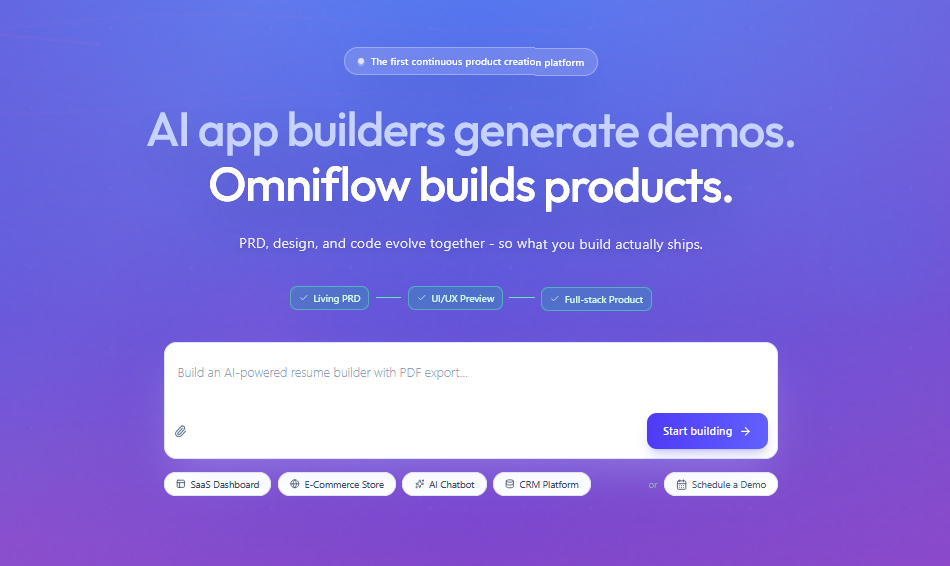 #13 - Omniflow: The Continuous Product Creation Platform
While many of the tools outlined above focus on one part of the development process, Omniflow takes a fundamentally different approach to the AI development platform category.
Instead of focusing solely on coding, machine learning infrastructure, or no-code UI builders, Omniflow is designed as a continuous product creation platform.
This means it helps product teams move through the entire product lifecycle:
Idea → Planning → Design → Development → Launch
Choosing the Right AI Development Platform
Choosing the right AI development platform depends on your goals and technical background.
For example:
Enterprise companies often choose Vertex AI or Azure ML
Developers may prefer Cursor or GitHub Copilot
Non-technical founders often use no-code builders like Bubble or Glide
AI-native product teams are increasingly adopting platforms like Omniflow
As AI development continues evolving, the tools that combine speed, automation, and product workflows are becoming increasingly valuable.
Platforms like Omniflow represent a new generation of AI development platforms designed specifically for building modern software products.
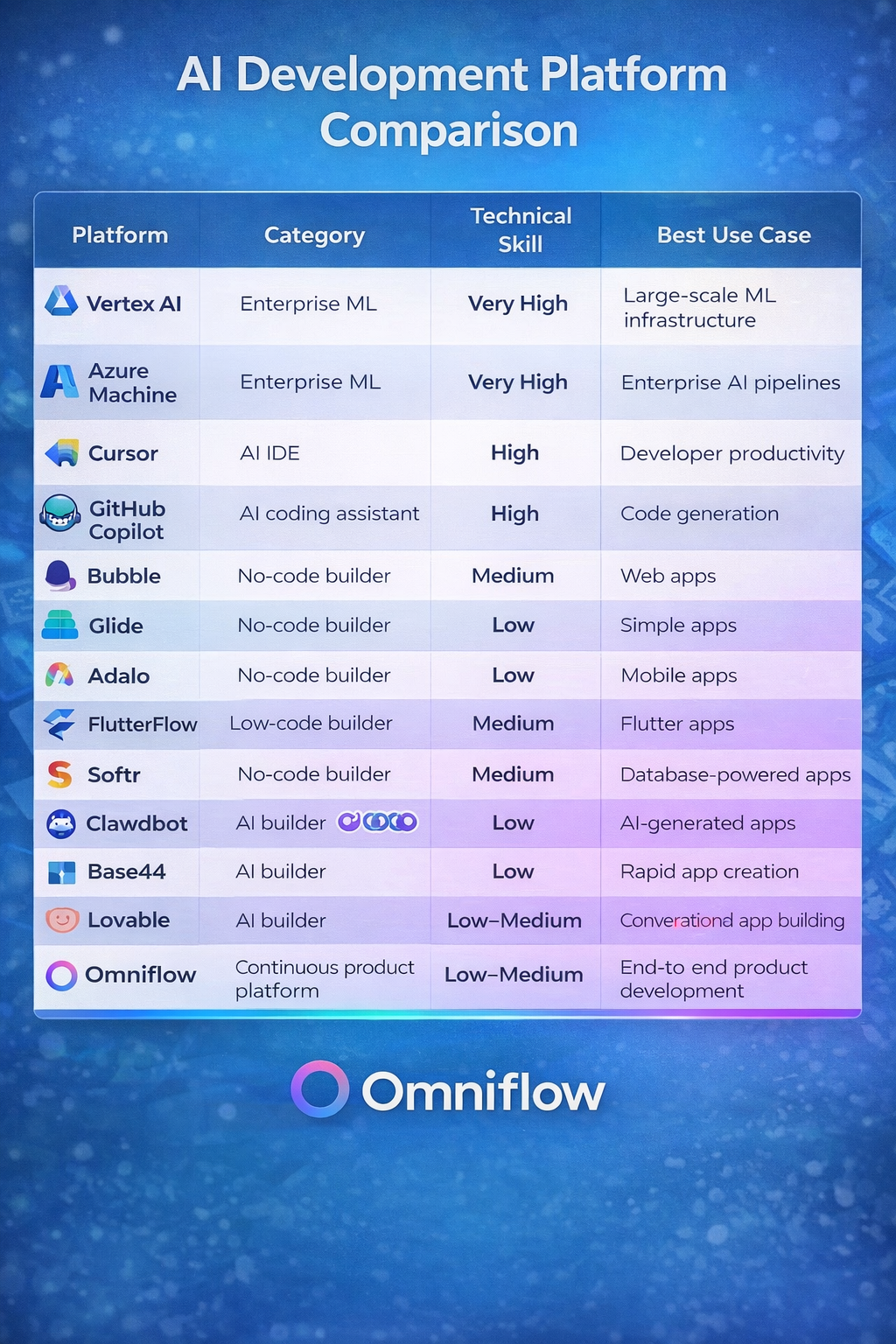
AI Development Platform Comparison
Here’s a quick comparison of the key differences between these AI development platforms.
 What Makes Omniflow Different?
Omniflow combines multiple AI capabilities into one integrated platform. We also have a new suite of free AI tools for founders, PMs and product teams that help validate ideas and get the ball rolling on exciting new project ideas.
Some of best features and tools include:
AI-assisted development workflows
Start Building AI Products Faster With Omniflow
While many platforms focus on individual parts of the development process, Omniflow helps founders and product teams move through the entire product lifecycle — from idea to launch.
If you're looking for a modern AI development platform designed for continuous product creation, Omniflow offers a faster and more integrated approach to building AI-powered products.
Sign up today and try Omniflow for FREE!
FAQ - The Best AI Solutions & AI Frameworks For Development in 2026
What is the difference between an AI development platform and a no-code builder?
An AI development platform may include tools for building machine learning models, AI-powered applications, or automated workflows. In contrast, a no-code builder focuses on creating apps visually without writing code. Some modern platforms, like Omniflow, combine both approaches by using AI to help teams design, plan, and build products faster.
Do I need coding experience to use an AI development platform?
It depends on the platform. Enterprise tools like Vertex AI and Azure Machine Learning typically require strong programming and data science knowledge. However, newer platforms such as Bubble, Glide, and Omniflow allow users to build AI models and AI-powered apps with little or no coding experience.
Which AI development platform is best for startups?
Startups often prefer platforms that allow them to move quickly and validate ideas faster. Tools like Bubble, FlutterFlow, and Omniflow are popular among founders because they reduce development time and allow teams to build products without large engineering teams.
What features should I look for in an AI development platform?
When choosing an AI development platform, it’s important to consider ease of use, AI capabilities and integrations, scalability, development speed, cost, and support for product development workflows. Platforms that streamline multiple parts of the product lifecycle, such as Omniflow, can often provide the most value for startups and product teams.
Can AI development platforms build entire applications?
Yes. Many modern AI development platforms can help generate code, build user interfaces, create product documentation, and even deploy applications. Newer platforms like Omniflow focus on continuous product creation, allowing teams to move from idea to working product much faster than traditional development workflows.
What are examples of AI development platforms?
Popular AI development platforms include Vertex AI, Azure Machine Learning, Cursor, GitHub Copilot, Bubble, FlutterFlow, and Omniflow. Each platform serves different use cases ranging from enterprise machine learning infrastructure to AI-powered application development.
Are AI development platforms replacing developers?
AI development platforms are designed to assist developers rather than replace them. Tools like GitHub Copilot or Cursor help automate repetitive coding tasks, while platforms like Omniflow help product teams move faster from idea to launch.