How To Achieve Faster Iteration With A Living PRD In-Sync
 Modern product development teams are moving faster than ever.
Ideas need to be validated in days, not months. Product managers need MVPs shipped in weeks. Feedback loops are shorter and success metrics are more narrow. Ultimately, expectations are higher across the board.
And even though tools have evolved, it's still a fast-paced and highly competitive landscape where one core challenge remains:
Keeping everyone aligned as products change.
Product requirements documents or PRDs are supposed to solve this. But in reality, they often become outdated, fragmented, and disconnected from the work being done.
In our experience, traditional PRDs and static files can actually hinder alignment, becoming misaligned with ongoing work and creating silos that prevent teams from staying up to date.
As more teams adopt AI-powered platforms like Omniflow, a new opportunity has emerged: the living PRD. A document that evolves alongside your product. A living system that fosters shared understanding and knowledge bases that keep everyone on the same page as decisions, iterations, and execution unfold.
To support this new way of working, Omniflow recently introduced two improvements that quietly make a big difference: contextual generation feedback and built-in PRD versioning with diffs.
Together, they help teams iterate faster, transforming the product requirements document (PRD) into a dynamic, living system without losing clarity.
The Hidden Friction of AI-Powered Workflows
AI has transformed how products are built. Tasks that once took days now happen in minutes. Drafting requirements, fine-tuning UI and UX, exploring features, and testing concepts are all now accelerated and can be done quicker than ever.
But speed alone isn’t enough.
When teams rely on AI, uncertainty sometimes creeps in.
You’ve likely experienced this when using AI-powered tools: You submit a prompt. The interface goes quiet. Nothing changes. No progress indicator. No feedback.
You start wondering: Did it freeze? Did something break? Should I refresh? Should I try again?
When multiplied across dozens of interactions per day, it adds up into a lot of time that could be spent on more important tasks, which brings us to our first problem.
Problem #1: “Is It Thinking or Is It Broken?”
In today's fast-paced world, users expect instant responses. We're so used to apps and browser that work instantly, even short delays can be frustrating and feel like they're taking forever.
But with AI systems, generation takes time. Processing context, analyzing inputs, and producing structured output isn’t instantaneous. Yet many platforms still treat these minor delays as something all users know and understand.
But if you ask us, a responsive user interface is critical for maintaining user trust and minimizing frustration during AI development.
Solution: Contextual Generation Indicators
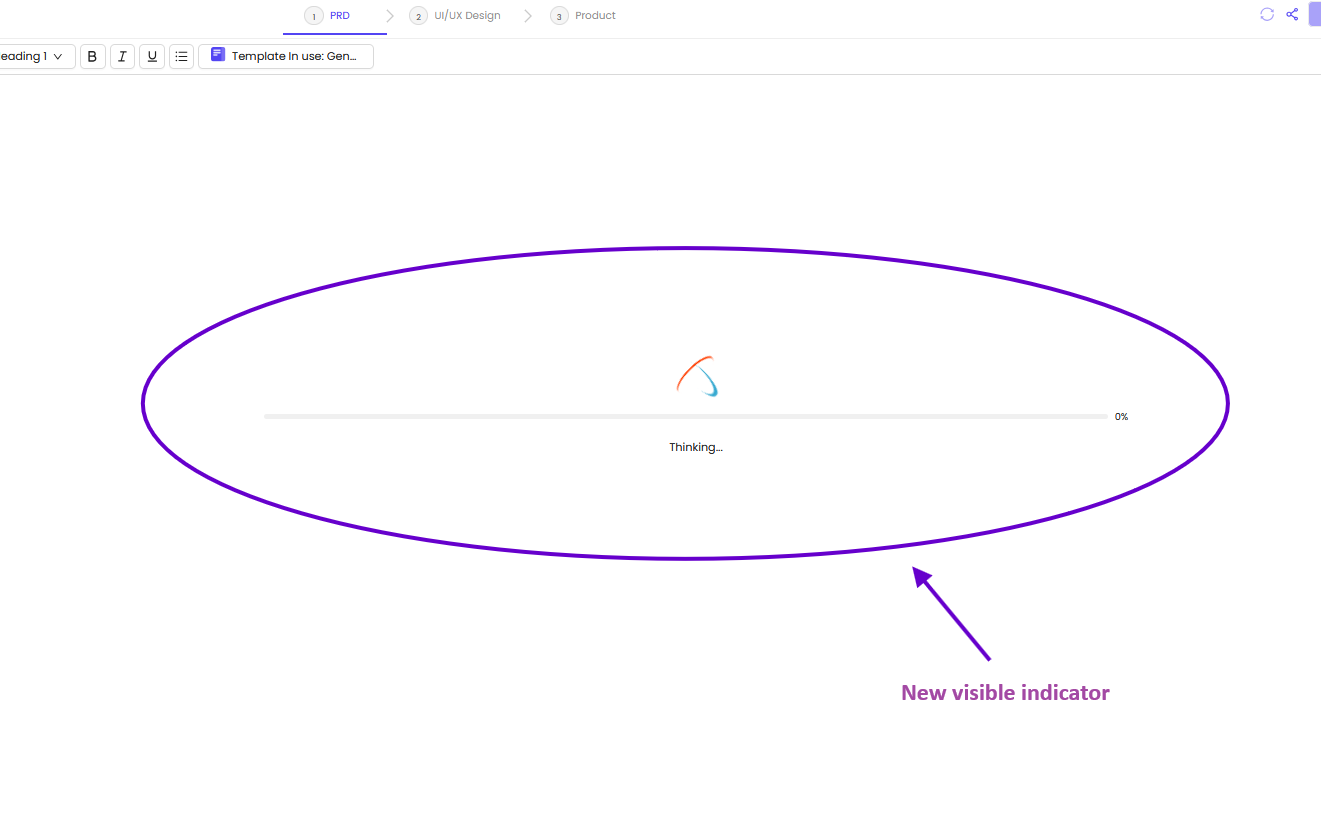
Omniflow’s new generation spinner changes this experience. When a PRD is being generated, you now see it happening.
You get a clear, visible indicator that shows when work is in progress. No more guessing. No more refreshing. No more uncertainty.
This small UI change delivers something critical in Omniflow's performance: confidence.
Users know the system is working. They stay focused. They can think ahead. And they can prepare next steps.
This new feature might not be the most revolutionary. But it's one that reduces frustrations. And that matters more than most teams realize.
Wondering about the difference between Lovable, Omniflow and other similar no-code development tools? Click here to read our full breakdown on Lovable vs Omniflow and learn how to choose the best AI product agent.
Why Transparency Accelerates Product Work for Product Managers
Transparency isn’t just about information. It’s about mental load too. When people understand what’s been changed, what still needs to change, and what their product looks like now, they don’t waste as much time or energy worrying about it.
With contextual feedback, attention stays on the problem being solved, cognitive friction is reduced, decision-making stays fluid, and project momentum is preserved.
Efficient, shared workspaces ensure whole teams remain informed and aligned, from start to finish, further reducing project friction and keeping everyone up to date in real time.
Basically, when teams can communicate clearly, they move faster, which brings us to our second problem.
Problem #2: The Chaos of PRD Revisions
Another major friction point in product development is version management. After all, PRDs change constantly. Features are added. Assumptions are corrected. Scope is refined. Feedback is incorporated.
Over time, multiple versions emerge and PRD names end up looking like this:
V1.
V2.
Final_v3.
Final_final_v4.
Latest_FINAL_really_this_time.
Sound familiar?
No matter how efficient a team may be, managing multiple features and the sheer volume of changes that take place can be overwhelming without a standardized PRD template to keep everything organized and consistent.
Without proper PRD versioning, teams struggle to answer simple questions, such as:
What changed? Why did it change? Who requested it? Does engineering know? Is design aligned?
Manual comparisons are slow. They’re error-prone. They discourage frequent iteration. As a result, teams either over-document or under-communicate.
And neither scales.
Solution: Built-In PRD Versioning With Diffs
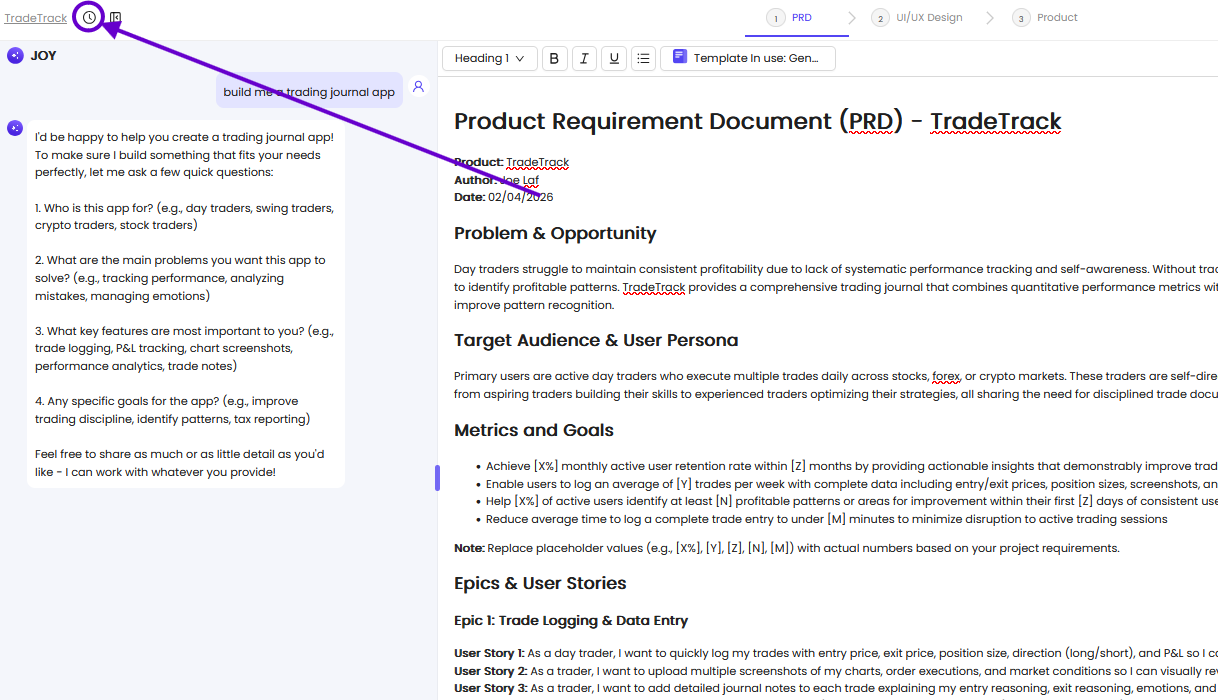
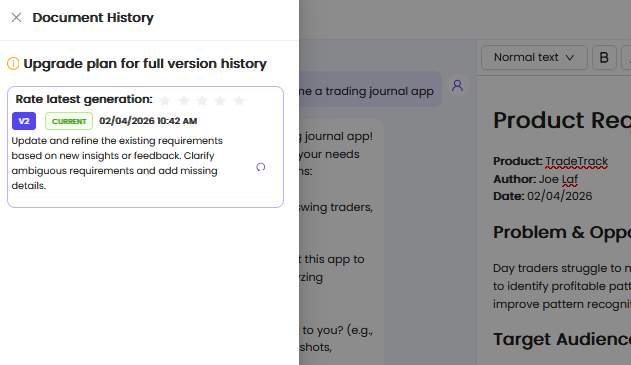
Omniflow now includes PRD versioning with diffs.
Every time a PRD is generated or updated, you can instantly see:
What’s new
What was modified
What stayed the same
This approach creates a single source for detailed specifications and technical requirements, ensuring accuracy and traceability.
No manual comparisons. No side-by-side documents. No guesswork.
The system highlights changes automatically, transforming your PRD from a static file into a living artifact. In other words, it becomes a PRD that reflects the true state of the product at all times. Not just a static document that becomes outdated fast.
 Why Version Visibility Changes Everything For Product Teams
When changes are visible, teams behave differently. They iterate more confidently. They review more carefully. They communicate more precisely.
But not only does Omniflow now allow PRD versioning, you can now see built-in diffs that enable:
Faster stakeholder approvals
Clearer engineering handoffs
Better design alignment
Easier audits and reviews
Reduced misinterpretation
Clear acceptance criteria and automated status updates
Instead of debating what changed, teams can now focus on whether a change is right.
And that’s a powerful shift, if you ask us.
What Is A Living PRD? The Rise of the Living Product Requirements Document
Together, generation feedback and version tracking support a new model of documentation: the living PRD.
A living PRD is:
Continuously updated
Always current
Fully traceable
Shared across roles
Integrated into workflows
Supports the development process
Enables cross-functional teams to collaborate seamlessly
It’s not a snapshot. It’s a system. And when paired with Omniflow's powerful AI product agent, it becomes a strategic asset.
Building Products With Clarity at Every Stage Of The Development Process
Product development should no longer be linear. It’s iterative, collaborative, and continuous.
Modern tools must support that reality.
By adding contextual generation indicators and built-in PRD versioning, Omniflow reinforces its core philosophy:
Help teams move fast, without losing understanding along the way.
Our users now have more transparency while AI is working, less cognitive load when reviewing outputs, and faster iteration across the board without losing context.
That’s what a modern product platform should deliver. And it’s what Omniflow is constantly building toward.
Ready to try it out for yourself? Sign up today and try Omniflow for FREE!
FAQ Section - The Essential Components Of Modern Product Strategy
What is a “living PRD” in product development?
A living PRD is a product requirements document that evolves alongside your product. Instead of being a static file, it is continuously updated, versioned, and synced with decisions, feedback, and development progress.
How does Omniflow help teams iterate faster on PRDs?
Omniflow uses AI to generate and update PRDs quickly while providing real-time feedback and version tracking. This allows teams to review changes instantly, make decisions faster, and avoid manual rework.
Why is generation transparency important in AI tools?
Without clear feedback, users don’t know whether an AI system is processing or has stalled. Omniflow’s generation indicator removes uncertainty, helping users stay focused and maintain momentum during workflows.
What are PRD diffs and why do they matter?
PRD diffs show exactly what changed between document versions. They highlight new content, edits, and unchanged sections, making reviews faster and preventing miscommunication between teams.
How does PRD versioning reduce mistakes in development?
Versioning ensures everyone is working from the latest requirements. By clearly showing updates, it prevents teams from building based on outdated assumptions or missing important changes.
Is Omniflow suitable for agile and iterative workflows?
Yes. Omniflow supports continuous iteration by keeping PRDs synchronized with evolving product decisions, making it ideal for agile, lean, and rapid development environments.
Do I still need external documentation tools with Omniflow?
In most cases, no. Omniflow centralizes PRD creation, versioning, and updates within one platform, reducing the need for separate document management systems.