What Is Clawbot? A Beginner’s Guide to the Viral AI Assistant
 If you’ve spent any time in tech communities or on social media recently, you’ve probably seen people asking the same question as pretty much everyone else: What is Clawbot?
Sometimes written as “Clawdbot,” this open-source AI assistant has quickly gained attention for doing something many mainstream tools don’t, running locally on your device. It is a new tool in the AI assistant landscape, generating significant interest and discussion due to its recent emergence and all the hype surrounding its innovative approach.
But what exactly is Clawdbot? What can it do? And how does it compare to structured AI product agents like Omniflow?
In this guide, we’ll break it all down.
What Is Clawdbot?
Clawdbot is an open-source personal AI assistant that runs directly on your own computer instead of relying entirely on cloud-based servers.
Unlike most popular AI tools that process data remotely, Clawdbot allows users to run language models locally, giving them more control over privacy, performance, and customization. Compared to other AI assistants, Clawdbot even allows advanced users to tailor its features to their needs for broader accessibility.
The project was created by Peter Steinberger, a well-known developer and entrepreneur best recognized for building and selling PSPDFKit. Steinberger's background in developer tools and infrastructure helped shape Clawdbot into a practical, technically focused product.
Power users leverage Clawdbot for advanced automation, taking advantage of its ability to execute shell commands, write files, trigger actions, execute tasks, manage scheduled tasks, and perform real actions directly on their systems.
Clawdbot is often associated with the lobster emoji because of its name and the way it works by scraping or “clawing” through user data and configuration files.
The playful imagery and viral name has helped its popularity spread quickly across developer communities, adding a sense of personality to what is otherwise a powerful technical tool.
How Does Clawdbot Work?
Most mainstream AI agent tools rely on cloud infrastructure. You send a prompt, it’s processed on the same servers remotely as everyone else, and you receive a response.
While convenient, this model raises concerns about privacy, latency, and dependency on external providers.
Clawdbot works in much the same way as other AI tools. But it takes a different approach. Instead of sending your data to the cloud, it runs AI models locally on your machine.
This means:
Your prompts and data stay on your device
Processing happens on your own hardware
You’re not dependent on constant internet access
You have more control over performance and customization
Under the hood, Clawdbot integrates with local language models and frameworks that allow AI inference to happen on personal computers. The exact setup depends on your operating system and hardware, but once installed, it functions much like any other AI assistant, just without the cloud dependency.
Also, because it’s open-source, developers can obtain shell access and API keys to modify, extend, and improve the AI to suit their own needs.
 What Is Clawdbot Used For?
Clawdbot is a general-purpose AI assistant, which means it can be used for many of the same tasks as popular cloud-based tools that rely on remote access.
Most users interact with Clawdbot through messaging apps and messaging platforms such as Telegram, WhatsApp, Discord, and Slack, using it to perform simple tasks like answering general inquiries as well as more advanced operations.
A few other common use cases include:
Writing and Editing
Users often rely on Clawdbot to draft natural language articles, emails, documentation, and creative content. Because everything runs locally, it’s especially appealing for sensitive or confidential writing.
Coding Assistance
Developers use Clawdbot for code generation, debugging, refactoring, and documentation. It works well as a personal programming companion.
Research and Summarization
Clawdbot can summarize long texts, analyze documents, and help organize information without sending files to third-party servers.
Brainstorming and Ideation
From business ideas to product features, many users turn to Clawdbot for creative support and early-stage thinking.
Personal Productivity
Some people use it as a private assistant for planning, note-taking, and task organization.
Overall, Clawdbot appeals most to technically inclined users who value independence and control.
Why Has Clawdbot Gone Viral?
Clawdbot didn’t become popular by accident. There are actually several trends that have helped fuel its rapid growth.
First, there is growing interest in privacy-focused technology. As concerns about data usage increase, many users prefer tools that don’t rely on cloud storage. With Clawdbot control, you know exactly what the AI has access to. You can be sure that it's not sharing your data with other entities.
Secondly, local AI has become more practical for modern users. Improvements in consumer hardware mean laptops and desktops can now handle advanced AI models.
Third, community-driven development played a major role. Developers shared setups, tutorials, and improvements, helping Clawdbot spread organically.
Finally, and the most simple explanation is that the lobster branding and meme culture made it memorable. Just like we've seen with Dogecoin and other popular meme-based phenomenons, Clawdbot has gained popularity purely because it's fun, whimsical and memorable.
Together, these factors turned Clawdbot into a recognizable name almost overnight.
Clawbot vs Omniflow: What Are The Key Differences?
While Clawdbot is impressive, it serves a very different purpose compared to platforms like Omniflow.
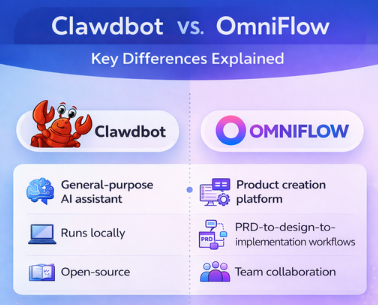
Clawdbot is best understood as a flexible AI tool. You use it to help you think, write, and code. You can use it to for code generation and programming assistance. But it's not actually meant to help users build software.
Omniflow, on the other hand, is designed to help teams build real software products, connecting PRDs, UI design, iteration, and development into a single, unified workflow. It's a full-scale product creation platforms that individual users, teams, and even enterprise clients can use
Clawdbot helps individuals work smarter. Omniflow helps organizations build better products.
Here’s how they compare side-by-side:
 When Should You Use Clawdbot vs Omniflow?
Choosing between Clawdbot and Omniflow depends on your goals.
You would use Clawdbot if you want a private AI assistant, prefer local processing, enjoy customizing tools, or want to focus on experimentation. However, you would use Omniflow if you want to build SaaS products, work with teams, need structured workflows, manage PRDs and iterations or want end-to-end product systems.
That being said, some users even combine both, using Clawdbot for personal ideation and Omniflow for professional product development.
The Future of Local Personal AI Assistants
Clawdbot represents a broader shift in how people think about AI.
Instead of relying entirely on centralized platforms, more users are exploring decentralized, personal AI systems. This trend is likely to grow as hardware improves and open-source models become more powerful.
At the same time, platforms like Omniflow are showing how AI can be integrated into full business systems and product development, not just individual tools.
If you ask us, the future will likely include both: private assistants and collaborative platforms, each serving different needs.
Conclusion: Understanding What Clawbot Really Is
So, what is Clawbot?
Clawdbot is a locally running, open-source AI assistant created for users who want control, privacy, and flexibility. It’s powerful, customizable, and especially appealing to developers and technical users.
But it’s not a replacement for structured product platforms like Omniflow.
Instead, it acts as a personal AI companion rather than a team-based system.
Understanding the difference between AI tools like Clawdbot and Omniflow help you choose the right tool for your goals.
Ready to develop your product ideas into a usable web app? Sign up today and try Omniflow for FREE!
Frequently Asked Questions (FAQs)
Is Clawdbot safe to use?
Yes. Because Clawdbot runs locally, your data stays on your device. However, safety also depends on how you install and configure it, so it’s important to follow official documentation.
What can Clawdbot do?
Clawdbot can write text, assist with coding, summarize documents, brainstorm ideas, and support general productivity tasks.
How does Clawdbot work?
It runs AI models directly on your computer or mobile device, processing prompts locally instead of sending them to remote cloud servers.
Is OpenClaw free?
Yes. OpenClaw and related components are open-source and free to use, though hardware requirements may apply.
Clawbot vs Clawdbot – what’s the difference?
“Clawbot” is often used informally, while “Clawdbot” refers to the actual project. In practice, most people mean the same tool.
Do I need programming skills to use Clawdbot?
Basic technical knowledge helps with installation, but once set up, many features are user-friendly.
Can Clawdbot replace cloud-based AI tools?
For some users, yes. For others, cloud tools may still offer better performance or convenience.
Does Clawdbot work on all devices?
It works best on modern desktops and laptops with sufficient processing power. Older devices may struggle.
Is Clawdbot good for building software products?
It’s useful for ideation and coding assistance, but for full product development workflows, platforms like Omniflow are more suitable.
What's the difference between Clawdbot and Moltbot?
Creator Peter Steinberger recently changed Clawdbot's name to Moltbot after coming under pressure from Anthropic due to similarities with the name to the Claude family of large language models.