
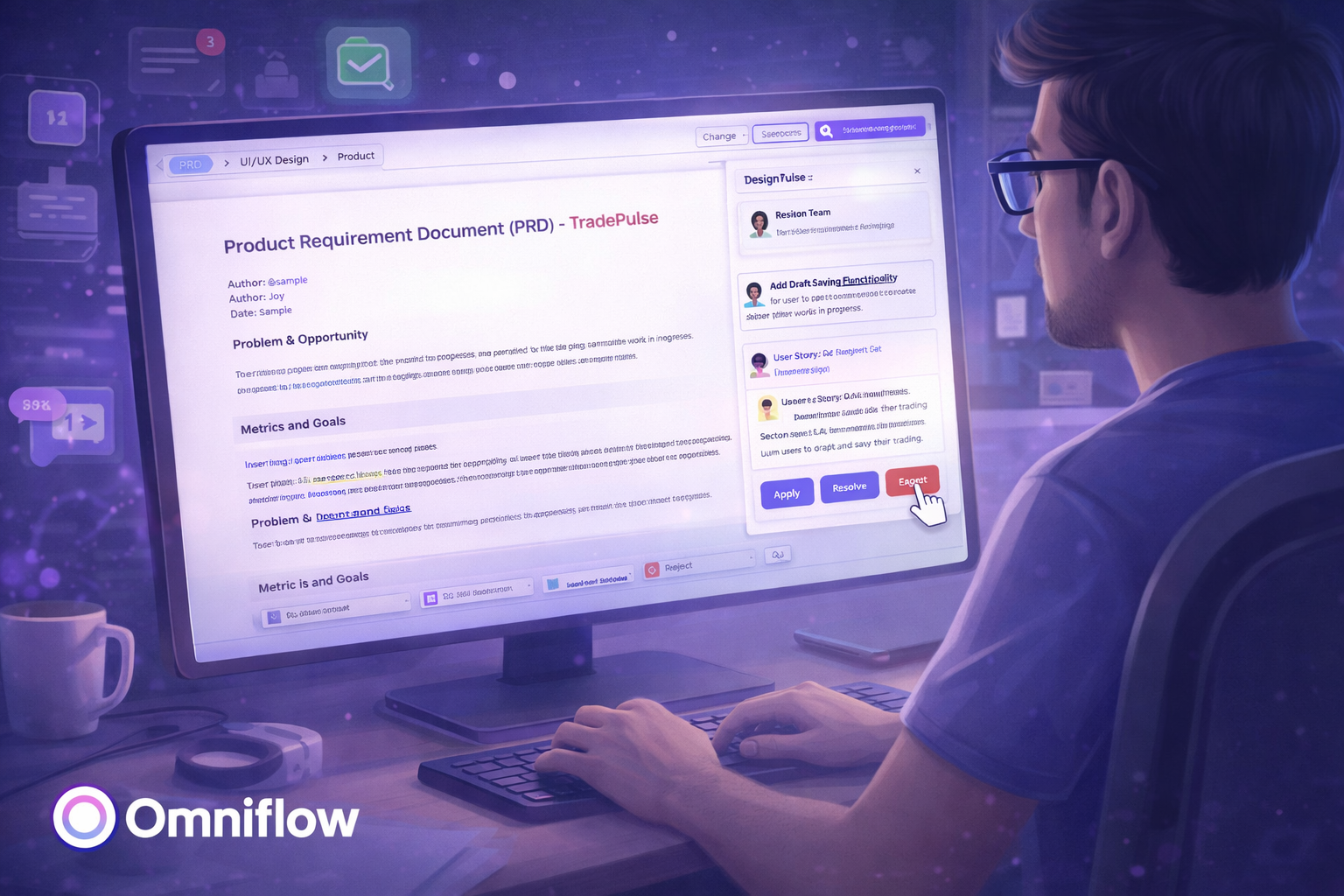
 If you’ve ever worked on a fast-moving product team, you’ve likely experienced this:
Your PRD says one thing. The design doc says another. And your product specs haven’t been updated in three sprints.
This isn’t a rare case. It’s a structural problem in how modern product teams manage documentation across PRDs, design systems, specs, and engineering workflows.
The issue is that documentation often falls out of step with development. PRDs then fail to provide the same information to all teams, leading to misalignment and confusion across the organization or company.
That’s exactly why we built cross-document synchronization for product teams into Omniflow, to centralize files and create a knowledge base for the entire organization or company.
That said, this isn’t just another collaboration feature. It’s part of our broader vision: building a full-scale product intelligence infrastructure that keeps documentation aligned as products evolve.
Features like this help teams achieve shared goals and ensure everyone is working from the same up-to-date knowledge base.
The Real Problem With Traditional Workflows: Documentation Drift
As projects grow, so do the documents supporting them.
Product managers update requirements. Designers revise components. Engineers adjust technical specs. And stakeholders request scope changes. But documentation rarely updates in perfect sync, especially across so many different channels.
Over time, teams face:
Conflicting requirements
Outdated design references
Specs that no longer reflect shipped features
Endless copy-pasting between documents
Misaligned priorities and unclear objectives
The result is friction, confusion, and slower delivery.
Traditional tools treat all documents types as static artifacts. But Omniflow understands that product development is dynamic. So, your product requirements documentation should be too.
The traditional static approach makes it difficult to identify patterns, align on a strategic plan, and ensure everyone is working toward shared priorities and objectives.
That’s where cross-document synchronization for product teams changes the game, by enabling teams to access updated documents and move their development and research in the right direction.
 What Cross-Document Synchronization Actually Means
In Omniflow, your living PRD sits at the top of a structured hierarchy, which means when you update your PRD:
The design doc is automatically notified
Downstream product specs receive proposed updates
Engineering documentation reflects those changes
Every change is traceable and reviewable
Changes cascade, but are never blindly rewritten.
You can even use Omniflow's Knowledge Base feature to create create a single source of truth that can be updated, maintained or modified to ensure the right data is referenced and accessible across documents, giving product teams flexibility and control over their sync process.
One of the best parts about the new feature is that each step requires confirmation.
Product managers, designers, and engineers remain in control, streamlining collaboration and ensuring the right people can update products as needed. Essentially, you don’t lose governance, you gain clarity.
Cross-documentation synchronization isn't just about automation. It’s about structured alignment.
Here's a closer look at the feature and what it means for future products.
No More “Which Doc Is the Latest?”
One of the most common frustrations in larger projects is version confusion. Which document reflects your team's current reality?
The Notion page?
The design spec?
The Jira ticket?
The original PRD?
This confusion often arises because these are separate documents, each updated independently.
Therefore, establishing a single source of truth is the solution that keeps all separate documents aligned from the first place, ensuring everyone works from the same, reliable information.
With cross-document synchronization for product teams, there is no ambiguity. You make changes once. You sync everywhere. No more manual duplication. No more reconciliation meetings. No more guessing.
Your documentation evolves together.
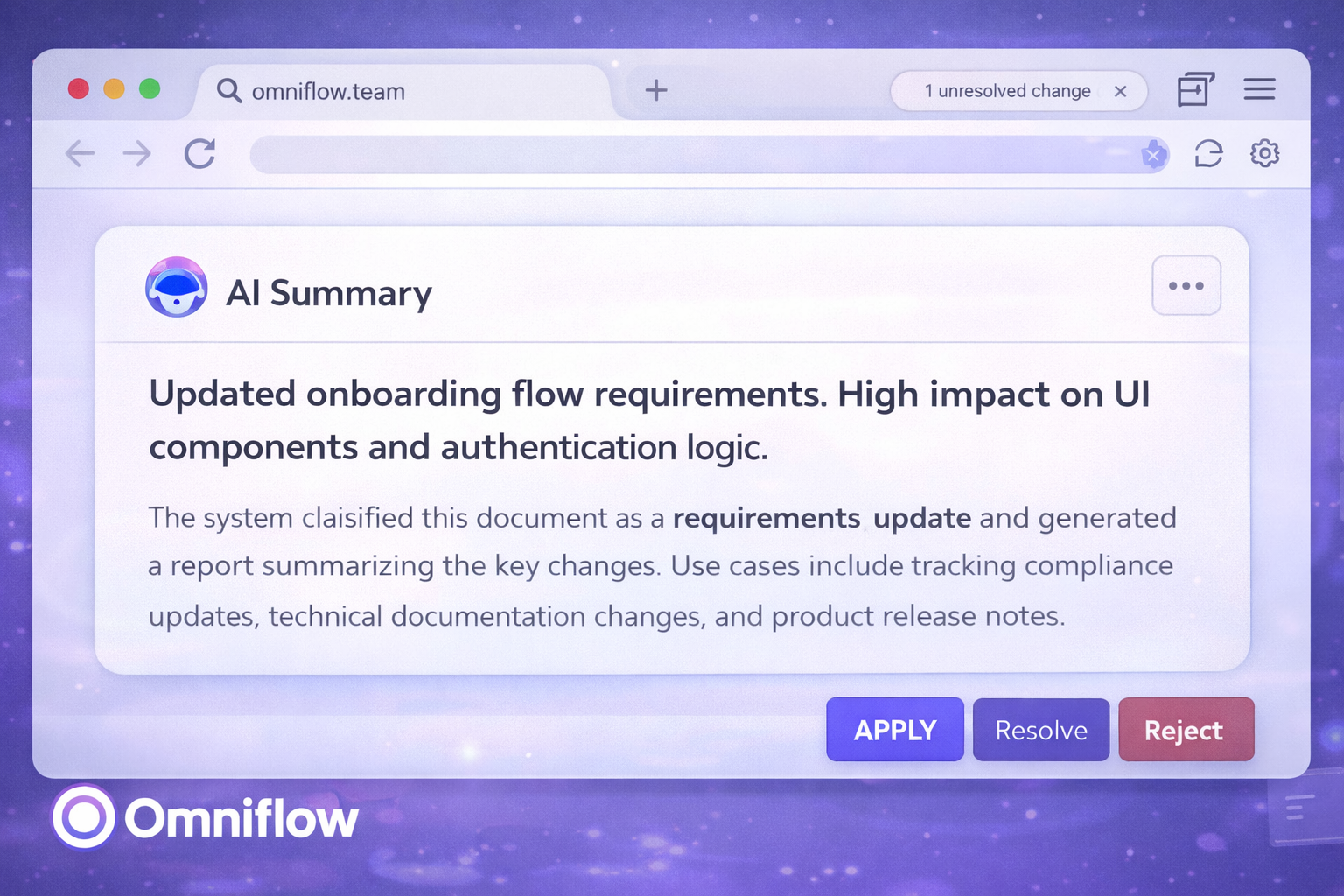 AI-Generated Change Summaries and Impact Assessment As A Single Source of Truth
What makes this update especially powerful is the intelligence layer behind it. Every change triggers:
An AI-generated summary
A contextual impact assessment
A clear explanation of what changed and why it matters
For example, once you make changes, you'll get a basic summary of those changes and why they're important, which will look something like this:
Updated onboarding flow requirements. High impact on UI components and authentication logic. The system classified this document as a requirements update and generated a report summarizing the key changes. Use cases include tracking compliance updates, technical documentation changes, and product release notes.
Instead of diffing documents manually, you instantly understand the implications.
From there, you can:
Apply the change
Resolve conflicts
Reject the proposal
This is where cross-doc sync becomes more than a syncing mechanism. It becomes a decision-support system powered by advanced document processing, machine learning, and generative AI, enabling you to build better products from the ground up.
Downstream Directives, Upstream Governance
We also designed cross-document synchronization for product teams with hierarchy in mind.
The living PRD remains the source of truth. Downstream changes flow as directives. Upstream proposals, however, can be rejected.
But, if a proposed change is rejected or deleted:
The source document reverts automatically
Feedback is attached
The audit trail remains intact
This helps to prevent uncontrolled scope creep while still enabling collaboration across teams. It leads to more structured flexibility, not growing chaos.
Built for Product Managers, Engineers, and Spec Specialists
This feature was built specifically for:
Product managers managing evolving requirements
Engineering teams maintaining technical accuracy
PRD workflow specialists ensuring consistency
Developers who need documentation they can trust
Users and customers who require solutions tailored to their specific business and market needs
Omniflow isn’t a one-stop shop or a basic no-code app builder.
We’re building product intelligence infrastructure, systems that ensure your documentation, design, and code evolve in sync.
And cross-document synchronization is a foundational layer of that infrastructure.
 The Bigger Vision: Product Intelligence Infrastructure
Most tools help you write documents. Omniflow helps you orchestrate them.
When documentation becomes:
Living
Hierarchical
AI-assisted
Synchronized
Your team spends less time managing artifacts and more time building products.
This latest update drop removes one of the most persistent sources of friction in product development: documentation drift.
Now, you can makes changes once and sync everywhere. That’s the power of intelligent cross-doc sync.
By giving users the ability seamless cross-document synchronization, your team is positioned for the future of product development and workflow automation, ensuring you’re ready to adapt to new challenges and innovations as they arise.
If you’re interested in how we’re evolving product workflows with AI, you can explore more insights, tips, and frequently asked questions and answers on our blog. Or, if you’re ready to try it for yourself, sign up today and try Omniflow for FREE!
FAQs
What is cross-document synchronization for product teams?
Cross-document synchronization for product teams ensures that changes made in one document, such as a PRD, automatically notify and update related design docs, specs, and downstream product documentation in a structured and controlled way.
How is cross-doc sync different from simple document linking?
Simple linking connects documents manually. Cross-doc sync actively tracks changes, proposes updates across documents, generates AI summaries, and maintains a structured approval workflow.
Can changes be rejected?
Yes. Upstream proposals can be rejected, and if they are, the source document automatically reverts with feedback attached, preserving governance and traceability.
Does cross-document synchronization replace version control?
No. It enhances documentation workflows by ensuring structured alignment between PRDs, design documents, and product specs while maintaining an audit trail of all changes.
Who benefits most from this feature?
Product managers, engineering teams, PRD workflow specialists, and developers working on complex, multi-team projects benefit most from cross-document synchronization for product teams.