
 Artificial intelligence is no longer a future trend. It’s already reshaping how businesses operate, how products are built, and how work gets done. But how fast is AI actually being adopted? How many companies are using it? And is AI really replacing jobs, or just changing them?
In this article, we break down the latest AI statistics, along with key data on workforce disruption, productivity, and what this all means for the future of work in 2026.
How Fast Is Generative AI Adoption Growing?
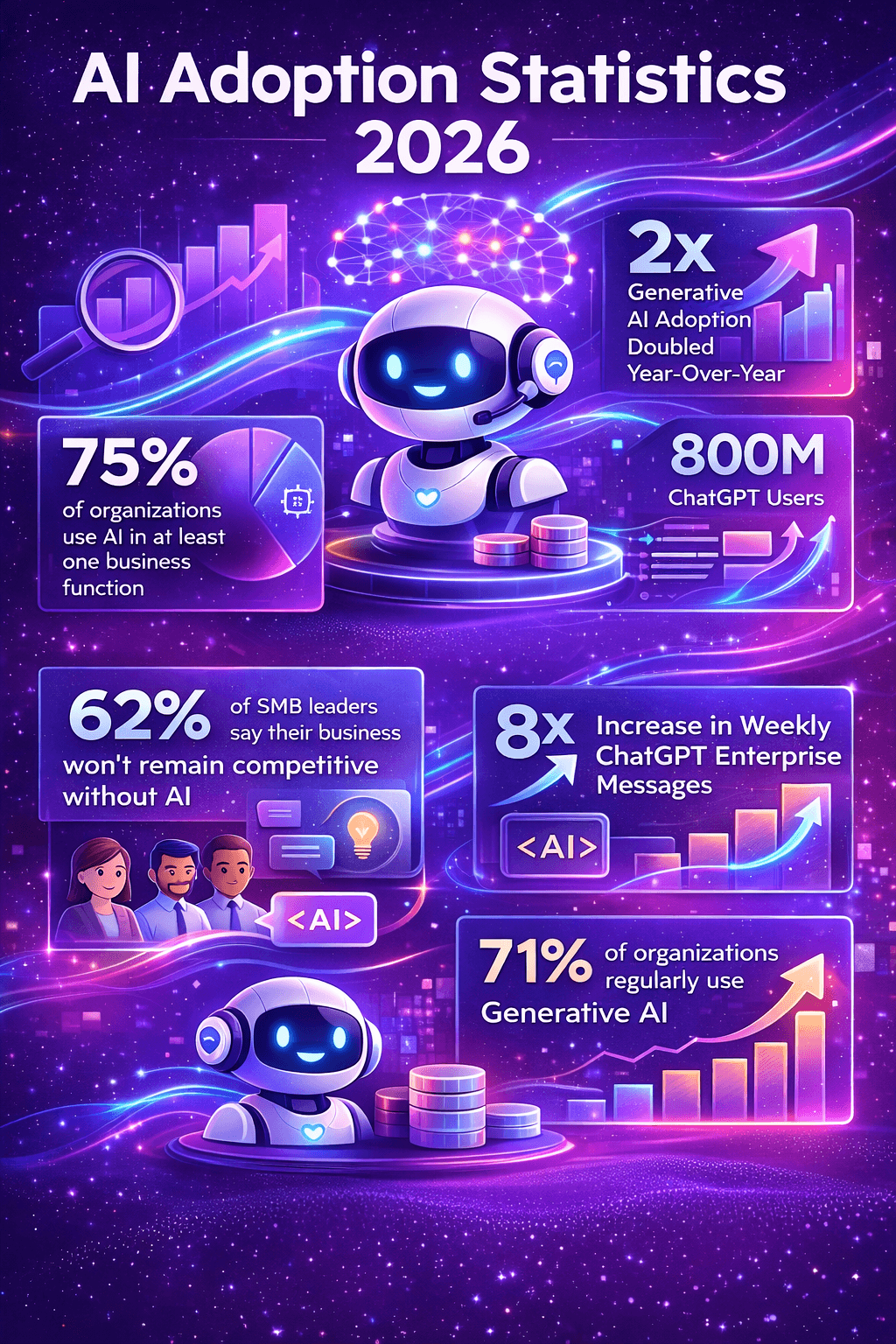
AI adoption has accelerated at a pace few technologies have matched. Over 75% of organizations report using AI in at least one business function. Generative AI adoption alone has also more than doubled year-over-year since 2023. And while nearly 1 in 3 companies are now actively deploying AI across multiple departments. some estimates believe that these numbers are actually understated.
When you look at the number, this isn’t just experimentation. It’s widespread integration, which is why many are referring to our current era as the AI revolution. Businesses are moving beyond pilots and proof-of-concepts toward embedding AI directly into workflows, products, and decision-making systems.
How Many Businesses Are Using AI Tools in 2026?
One of the most important statistics we've found is just how widespread AI usage has become in the workplace. Recent data shows that small and mid-sized businesses are adopting AI faster than ever due to accessible tools, like low-code and no-code product builders. What's more is that 62% of SMB leaders say that without AI, their business will not remain competitive within three years.
Furthermore, enterprise adoption is growing at an unprecedented pace. OpenAI states that ChatGPT now has more than 800 millions users in total. They also say that, over the past year, weekly messages in ChatGPT Enterprise increased roughly 8×, and the average worker is sending 30% more messages. On top of that, 71% of organizations report using generative AI tools regularly
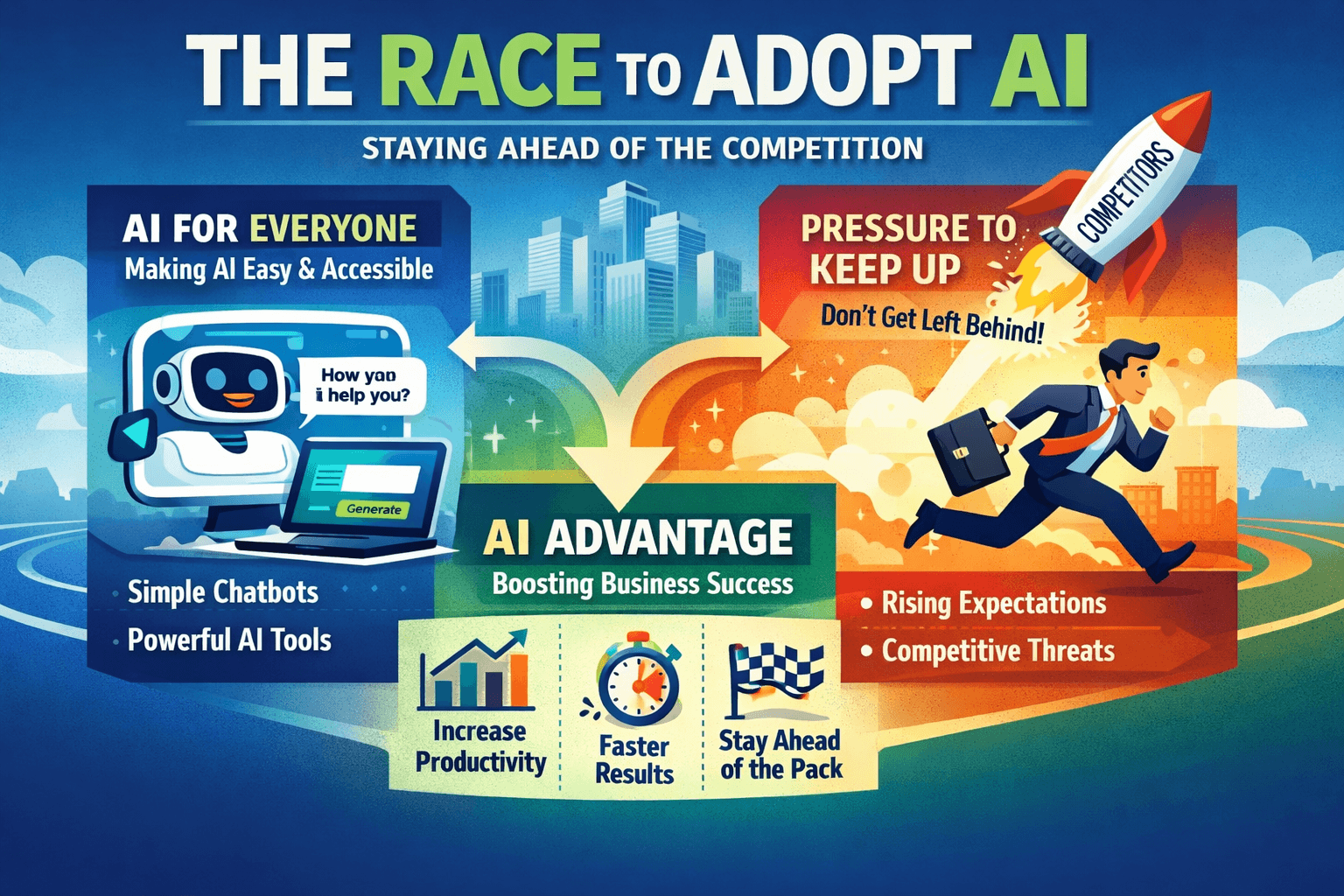
What’s driving this mass adoption rate? It's believed that lower barriers to entry (no-code and AI development platforms), immediate productivity gains, and competitive pressure is a major force in the widespread adoption. After all, companies that aren’t adopting AI are increasingly at risk of falling behind.
 What Are Companies Using AI For?
AI isn’t being used in just one area. It’s spreading across entire organizations. The most common use cases include:
Content generation and communication
Customer support automation
Data analysis and forecasting
Workflow automation and internal tools
This is where AI adoption statistics become especially interesting. Instead of replacing entire roles overnight, AI is automating tasks, accelerating workflows, and enhancing decision-making. While many fear that AI is replacing jobs like software developers, we believe that AI will only improve productivity, enhance output, and make traditional jobs more efficient than before.
AI Replacing Jobs Statistics - Is AI Replacing Jobs?
This is one of the most searched, and misunderstood, questions about modern AI solutions and the widespread adoption of AI technologies. But what do the actual AI replacing jobs statistics actually say?
Well, some estimates believe that up to 30% of tasks across various roles could be automated by AI. Some reports even say that between 14% and 20% of the global workforce,or approximately 375 million works, may need to transition roles by 2030. However, research also shows something interesting and important: AI is more likely to transform jobs than eliminate them entirely.
What Jobs Is AI Replacing First?
AI tends to impact tasks. Not entire professions. Some of the most affected roles will likely include:
Data entry and administrative work
Basic customer service roles
Content generation at scale
Repetitive coding and debugging tasks
At the same time, demand is increasing for AI-literate developers, product builders, engineers who can work alongside AI, and creative and strategic roles. Yes, there are jobs that will be replaced by AI, but we strongly believed at AI adoption curve will simply transform worker productivity through ongoing AI initiatives and AI infrastructure that will only get better as time goes on.
How Is AI Changing the Way We Work?
The real story behind AI adoption statistics isn’t job loss. It’s workflow transformation. AI is enabling faster product development cycles, reduced time spent on manual tasks, more experimentation and iteration, and smaller teams building more complex systems.
Instead of replacing humans, AI is shifting where human effort is applied. The use of AI agents and AI systems means less time navigating tools and more time building, thinking, and creating.
Why AI Adoption Is Accelerating So Quickly
Several factors are fueling this rapid growth, which include ease of use, immediate ROI, competitive pressure, and the ability to integrate AI into existing tools.
Basically, modern artificial intelligence online chat interfaces and tools make AI accessible to non-technical users. Companies also face ongoing pressure from competitors. As more businesses adopt AI, others are forced to follow or fall short. Meanwhile, the ones who do integrate AI operations into their business models can see measurable gains in productivity almost instantly.
Finally, AI is no longer a standalone feature. It’s embedded directly into countless platforms and workflows. AI models today are capable of all so much more than they once were. They can handle complex supply chain management, streamline digital transformation, boost worker productivity, and integrate cutting edge technology into the way existing business already operate.
 What These AI Adoption Statistics Mean for Builders
For developers, founders, and product teams, these trends point to a clear shift. The bottleneck is no longer building technology. The bottleneck is now building efficiently. This is where platforms like Omniflow come in.
As AI adoption grows, tools are evolving to reduce friction across the entire product lifecycle, from ideation to deployment. Instead of stitching together multiple tools, teams are moving toward integrated environments where AI supports planning, designing, building, and iterating all in one place, from a single user dashboard.
The Future of AI and Work
So, what happens next? Based on current AI usage statistics, we can expect continued acceleration in AI integration across industries, more hybrid roles combining human expertise + AI capability, increased demand for tools that simplify development workflows, and a widespread shift from “AI as a feature” to “AI as a foundation.”
And perhaps most importantly... The winners won’t be those replaced by AI. They’ll be the ones who learn to use it best. AI is not just changing what we build. It’s changing how we build.
For anyone building products in 2026, understanding these AI adoption statistics isn’t optional—it’s essential. Because the future of work isn’t AI vs humans. It’s humans working with AI, which enables creativity faster, smarter, and with fewer limitations than ever before.
If you want to experience what that looks like in practice, you can start building with AI today.
👉 Try Omniflow for free and see how Intelligent Chat can transform your workflow.
FAQ: AI Adoption Statistics
How many companies are using AI in 2026?
Recent AI adoption statistics show that over 75% of organizations use AI in at least one business function, with many expanding usage across multiple departments.
What is driving the rapid growth of AI adoption?
AI adoption is accelerating due to lower barriers to entry, immediate productivity gains, and competitive pressure. Businesses that fail to adopt AI risk falling behind.
Is AI replacing jobs or creating new ones?
AI is more likely to transform jobs than eliminate them. While up to 30% of tasks could be automated, new roles are emerging that require working alongside AI systems.
What are the most common uses of AI in businesses?
Companies are using AI for content generation, customer support automation, data analysis, software development, and workflow automation.
How will AI change the future of work?
AI will shift work toward higher-value tasks, enabling faster development, increased productivity, and smaller teams building more complex products with greater efficiency.