How Generative AI Is Reshaping the Product Lifecycle from Ideation to Launch
 Generative artificial intelligence (AI) is no longer just a buzzword — it’s redefining how products are conceived, engineered, tested, and launched across enterprises.
Foundation models—large, versatile AI systems trained on vast amounts of unstructured data—are at the core of generative AI technology, powering a wide range of applications.
Early AI efforts often focused on narrow tasks like text generation or image creation. But now, the second wave of generative AI adoption is transforming the entire product lifecycle, enabling faster innovation, improved quality, and deeper alignment with customer needs.
Deep learning and machine learning are the core technologies that enable generative AI to create, optimize, and deploy advanced models for diverse data types and tasks.
From ideation and design to development workflows and go-to-market strategies, generative AI is driving a paradigm shift that empowers product teams to do more, faster, and with more precision than ever before.
Below, we explore how generative AI models are changing how products are designed, built, deployed and monitored.
Ideation and Concept Discovery Accelerated by Generative AI Models
Traditional ideation processes often rely on brainstorming sessions and manual research — which can be productive. But it's also slow, unstructured, and prone to missing promising directions.
Generative AI changes this dynamic by analyzing vast datasets — including market trends, competitor offerings, customer feedback, as well as existing data and input data — and surfacing novel ideas that humans might not have considered.
Generative AI can leverage both unlabeled data and labeled data as training data to improve ideation outcomes, ensuring diverse and high-quality idea generation.
For example, AI can generate product concepts based on unmet consumer needs, enabling teams to explore a wide range of possibilities without starting from a blank slate.
Academic research supports this shift: AI-assisted ideation tools have been shown to help innovation teams generate higher-quality ideas more efficiently, enhancing both time-to-market and creative output.
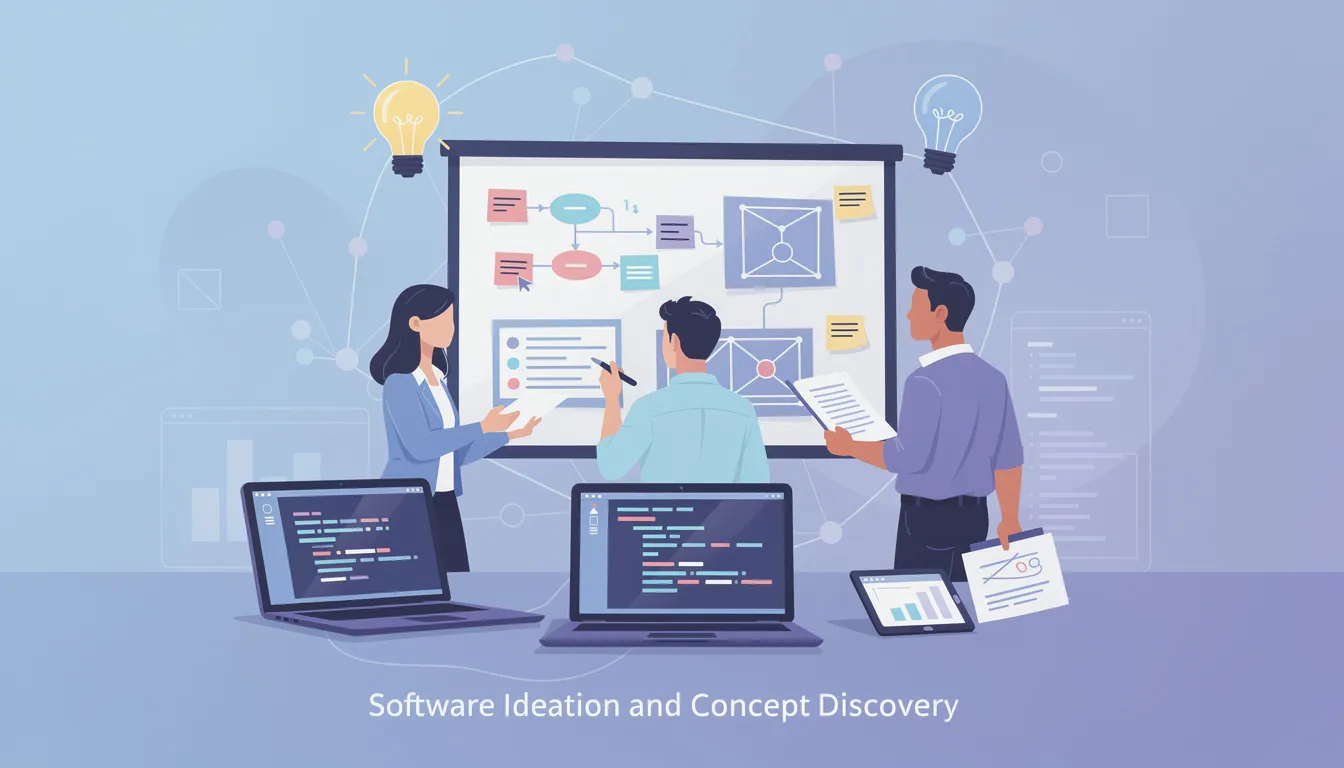 Language models and large language models are often used to generate new product concepts and support creative exploration in a fraction of the time.
Will software engineers be replaced by AI? It's unlikely. Rather than replacing human creativity, generative models act as idea amplifiers — suggesting concepts, surfacing patterns in data, and enabling product leaders to pivot faster with confidence.
Generative AI work and generative AI learn from data to continually improve ideation processes.
Smarter Prototyping and Design Optimization with Machine Learning
Once a product concept is chosen, the next hurdle is rapid prototyping — historically an expensive, time-consuming step. Generative AI accelerates this through automated design generation and simulation.
Instead of manually sketching, modeling, and iterating multiple prototypes, teams can prompt AI to create optimized design iterations based on performance constraints, manufacturing requirements, or user preferences.
Generative AI enables image generation to create realistic images and user interfaces for prototyping, allowing teams to visualize and refine concepts quickly.
Synthetic data, generated data, and data samples are also used to simulate and test design variations, providing a broader range of scenarios for evaluation. For instance, Airbus has used AI-driven generative design to produce lighter yet structurally sound aircraft components.
By simulating designs virtually, teams can iterate through countless versions, stress-test them in silico, and incorporate iterative improvements before any physical prototype is built — significantly cutting R&D costs and cycle times.
Engineering and Development Gets a Productivity Boost
Generative AI is also unlocking new workflows within engineering and software development.
Advanced code generation tools can produce preliminary code snippets, help identify bugs, or suggest architectural changes — allowing engineers to focus on higher-order problem solving rather than rote tasks.
These capabilities are enabled by architectures such as transformers, recurrent neural networks, and foundation models, which underpin the latest advances in generative AI.
Fine tuning and supervised learning are commonly used to adapt these models for specific engineering tasks, ensuring that generated outputs meet the unique requirements of each project.
 According to IBM, enterprise AI platforms are estimated to improve developer productivity by as much as 30% by automating repetitive phases of the software product lifecycle.
Moreover, AI doesn’t just write code — it helps enforce consistency, flag potential integration issues early, and ensure that development aligns with broader product goals.
With tools like Omniflow, PMs and team leaders can even harness features like auto-sync to PRD, which ensures changes made to prototypes or products are automatically tracked and added into the PRD.
Streamlining Go-to-Market and Launch Readiness
The final hurdle in the product lifecycle — launching a product and reaching users — is also being reshaped by generative AI.
Enterprises now use generative models to automate content creation (like product descriptions, marketing collateral, and localized messaging), optimize go-to-market strategies, and personalize customer experiences at scale.
AI tools are increasingly used to generate content for marketing and communication, streamlining workflows and boosting productivity. For example, with Omniflow, teams can easily build entire business-specific knowledge bases for both internal and external use.
Using generative AI also allows businesses to personalize and optimize customer engagement at scale, driving better results and deeper connections.
An important advantage here is consistency: AI-generated content can be aligned with strategic goals, ensuring that every piece of marketing communication supports positioning and brand voice while enabling rapid experimentation and A/B testing.
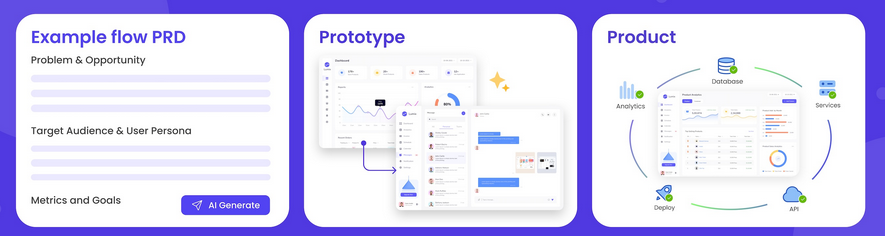 Omniflow and the Future of Foundation Models in AI-Enabled Product Development
As generative AI transforms every stage of the product lifecycle, tools that unify knowledge, workflows, and insights become essential. This is where platforms like Omniflow are enabling the next generation of product teams.
Omniflow integrates dynamic knowledge management with real-time data and collaborative workflows — effectively creating an environment where AI insight and human expertise coexist.
By capturing product documentation, design decisions, customer feedback, and development history in a centralized, searchable workspace, Omniflow helps teams avoid silos and maintain alignment throughout the lifecycle.
In the end, generative AI isn’t a hype cycle — it’s a structural shift in how products are built and brought to market.
As tools like Omniflow continue to help organizations capture knowledge, accelerate decisions, and amplify human creativity, the product lifecycle will become faster, more collaborative, and better aligned with customer needs than ever before.