
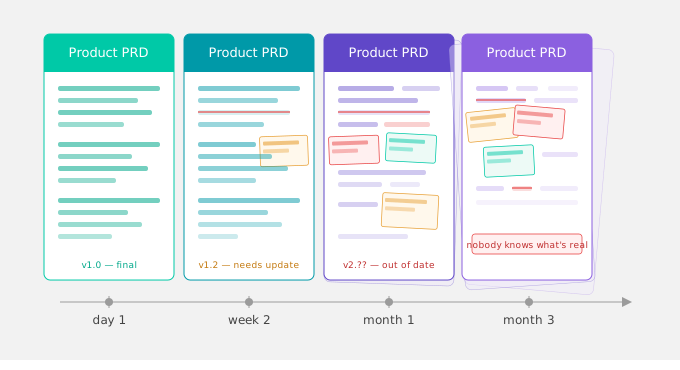
 You spent two weeks writing a Product Requirement Document. User stories, acceptance criteria, edge cases, priority tiers. You walked the team through it in a kick-off meeting. Everyone nodded. Engineering started the sprint.
By week three, the product looks different from what you wrote.
A button moved. A user role was consolidated. An API endpoint that was explicitly scoped in the requirements wasn't built because "it seemed redundant." Nobody made a malicious decision. Nobody ignored your spec on purpose. But the product drifted anyway, and your PRD, sitting in a Notion doc or a shared drive folder, never knew it happened.
This is the central problem with how most teams treat product requirements today. The issue isn't the quality of your writing or the level of detail in your specifications. It's structural. A PRD is a static document in a dynamic environment, and the moment it's handed off, it begins to lose its connection to the product it was meant to describe. Understanding why this happens and what to do about it is one of the more practical things a product manager can work on.
The job a PRD was designed to do
A product requirements document has one core job: to serve as the single source of truth that keeps product, design, and engineering aligned. Before a line of code is written, everyone should be able to look at the same document and agree on what's being built, for whom, and why.
In theory, this is a clean solution to a real problem. Building software requires dozens of decisions to be made in sequence, and misalignment at any point compounds into wasted work downstream. A well-written PRD reduces the surface area for misinterpretation. It forces the product team to think through edge cases before they become engineering debates mid-sprint.
In practice, most PRDs fail within two weeks of being written. Not because they were poorly written but because they were designed as handoff artifacts, not living systems.
Here's a concrete example of how quickly it happens. A PM writes a thorough spec for a user onboarding flow. The PRD describes a three-step setup wizard with specific field requirements, validation logic, and a confirmation email triggered at the end of step three. Engineering starts building. A designer reviews the prototype and suggests collapsing steps two and three because the UX feels repetitive. The engineer agrees, makes the change, and moves on. Nobody updates the PRD.
Two sprints later, a stakeholder reviews the product against the original spec and asks why the confirmation email is now triggering at step two. Engineering says it made sense given the UI change. The PM doesn't have a record of the decision. Design doesn't remember the conversation. The spec says something different from what shipped. And the team spends a meeting re-litigating a decision that was already made.
Multiply this across every sprint, and you have an organization that nominally writes detailed product requirements and functionally ignores them.
Where requirements actually break down
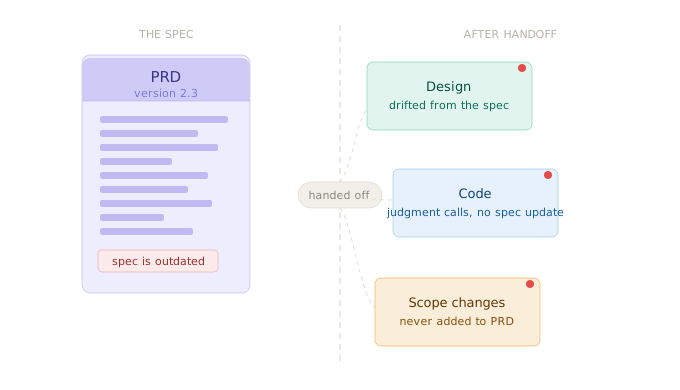
Requirement drift doesn't happen in one place. It accumulates across three distinct failure points, each of which feels minor in isolation but compounds into a significant alignment problem over time.
The handoff gap
The first failure point occurs when the PRD leaves the PM's hands. Between the time a requirement is written and the time an engineer reads it, assumptions get made on both sides. The PM assumes the spec is self-explanatory. The engineer assumes that anything ambiguous is intentional flexibility. When an implementation decision has to be made, and the spec is unclear, engineers do what reasonable people do: they use their best judgment. That judgment may be correct. It may also be the first step in a divergence that takes three sprints to discover.
This gap is particularly common in requirements that are technically clear but functionally ambiguous. A spec might say "users can edit their profile" without defining which fields are editable, whether edits require re-verification, or what happens to dependent data when a key field changes. An engineer builds a reasonable implementation. A PM reviews it and realizes two important cases weren't handled. Neither person did anything wrong; the spec just didn't have a structural connection to the implementation that would have surfaced the gap earlier.
The design drift
The second failure point is the design layer. UI and UX decisions get made during design reviews that don't make it back into the requirements document. A layout change that reorders user actions. A simplified flow that removes a step. A design system constraint that makes a specified interaction impractical. These are legitimate decisions. Good design often means questioning what was specified, but when it happens without updating the PRD, the spec, and the design, the spec and the design now describe two different products.
Traditional PRDs and static files can actually hinder alignment, becoming out of sync with ongoing work and creating silos that prevent teams from staying up to date. This is most evident at the design layer, where the speed of iteration makes it impractical to manually update a separate document whenever a UI decision changes.
The mid-sprint pivot
The third failure point is scope change. A stakeholder joins a design review and asks for something different. A competitor releases a feature that shifts priorities. A user interview surfaces a problem with the original approach. These pivots are part of product development; they're not failures, they're feedback. The failure is what happens to the documentation when they occur.
Without proper PRD versioning, teams struggle to answer simple questions, such as: what changed? Why did it change? Who requested it? Does engineering know? Is the design aligned? Manual comparisons are slow. They're error-prone. They discourage frequent iteration. The result is that teams either over-document, spending more time updating specs than building, or under-communicate, letting the PRD become a historical artifact rather than an active tool.
The compounding cost of a disconnected spec
Requirement drift doesn't announce itself. It accumulates quietly, and by the time it becomes visible, it has already cost the team significant time.
The most direct cost is realignment work, the meetings, Slack threads, and async back-and-forths that happen when the team discovers that the spec, design, and implementation are describing slightly different products. Research from the Project Management Institute has consistently found that a significant portion of project budgets, often in the range of 10–15%, is lost to poor requirements management and the rework it generates. For software teams working in two-week sprints, that translates to roughly one to two days of engineering capacity per sprint spent on work that wouldn't exist if requirements had stayed connected to implementation.
The less visible cost is decision quality. When engineers make implementation decisions without a clear spec because the spec is outdated, ambiguous, or missing, those decisions are made in isolation. They may be technically correct and product-incorrect. They accumulate into a codebase that reflects a series of individual judgment calls rather than a coherent product vision. This is the foundation of technical debt that isn't caused by shortcuts but a lack of shared context.
Most AI builders hand you a codebase and walk away. When requirements evolve, you re-prompt from scratch. The same pattern applies to manual processes: when the PRD isn't connected to what's being built, every change triggers a new re-alignment cycle rather than propagating a connected update.
For a PM, the most frustrating cost is influence. A product manager's ability to shape what gets built depends on having a specification that people actually reference during development. When the PRD is known to be outdated, it is no longer consulted. Decisions that should flow from product strategy get made at the engineering level. The PM's role becomes reactive, reviewing what was built rather than directing what gets built.
What changes when your PRD is connected to your product
The concept of a living PRD addresses the structural problem rather than the symptom. Rather than a document that describes a product at a point in time, a living PRD maintains a structural, live connection to the design and code that implement it. When a requirement changes, that change propagates downstream. When an implementation decision is made, it can be traced back to an approved requirement, and any drift from the approved spec is flagged rather than silently accumulated.
A living PRD is continuously updated, always current, fully traceable, shared across roles, and integrated into workflows. It's not a snapshot. It's a system.
The workflow difference is meaningful. In a traditional process, a PM updates the PRD, sends it to the team, and hopes the downstream layers catch up. In a connected workflow, updating the PRD automatically updates design and code; nothing falls out of sync because there is only one source of truth, not three separate documents that need to be manually reconciled.
Omniflow keeps your PRD, design, and code continuously aligned. Update the PRD so the design and code stay aligned. Adjust design and implementation updates automatically. Push new code,e and requirement drift is flagged for review.
The version control dimension matters too. Every time a PRD is generated or updated, you can instantly see what's new, what was modified, and what stayed the same. No manual comparisons. No side-by-side documents. No guesswork. The system highlights changes automatically. For a PM, this means the PRD is always the current record, not a snapshot from two sprints ago that nobody trusts.
The practical effect on team behavior is significant. When changes are visible, teams behave differently. They iterate more confidently. They review more carefully. They communicate more precisely. A PM working from a living PRD isn't spending sprint planning re-establishing what was already decided. They're making decisions about what comes next.
Dan Lazar, a PM at AutoTrader, put it concisely: with a connected PRD and instant updates, he can sell ideas and products smarter. Ken Fuire, CPO at incrediHire, described the productivity gain as an extraordinary boost across his entire product team. The common thread is the same: when requirements drive what gets built rather than just describing what was planned, the PM's role shifts from chasing alignment to creating it.
How to make your PRD matter beyond the planning phase
Whether or not you adopt a tool that automates the sync, there are structural improvements to how you write and maintain a PRD that significantly reduce drift.
The first is the specificity of acceptance criteria. Vague requirements are the primary source of the handoff gap. Rather than "users can edit their profile," write "users can edit display name, email, and avatar; email changes trigger re-verification; profile photo changes are reflected across the product within 30 seconds." Acceptance criteria should be testable, not interpretable.
The second is including data models and API requirements in the spec itself. Most PRDs describe features at the UI level and leave data architecture to engineering. This creates a gap in which the product team specifies behavior without specifying the data that drives it. When the data model is part of the PRD, engineering decisions about schema and API structure are made in the context of product requirements rather than in isolation. A comprehensive PRD should include a range of vital information: features, user roles, technical architecture, and database structure, not just user-facing functionality.
The third is establishing a change protocol that requires PRD updates before implementation changes. Any change to scope, design, or implementation should begin with a PRD update, not end with one. This is a process change, not a tooling change. It shifts the PRD from a record of what was decided to a control plane that governs what gets decided.
The fourth, and most durable, is adopting tooling that makes the sync automatic rather than manual. Omniflow transforms the PRD into a dynamic, living system without losing clarity. When the connection between requirements, design, and code is structural rather than manual, alignment doesn't depend on team discipline. It's the default state.
From handoff artifact to control plane
The shift worth making isn't about writing better PRDs. The format, the template, and the level of detail are secondary. The fundamental shift is from treating a PRD as a document you write before development begins to treating it as a system that remains connected to development as it evolves.
When your requirements document is connected to your product, it stops being a handoff artifact and becomes a control plane. Changes flow from it rather than diverging from it. The team works from a single source of truth rather than from three documents that contradict each other. And a PM's ability to shape what gets built survives contact with the engineering sprint. Here's a quick comparison of platforms for building apps in the market.
If you're ready to see what that looks like in practice, try Omniflow's Living PRD free, no credit card required. Or book a 20-minute demo to see how it fits your team's current workflow.
Frequently asked questions
What is a product requirements document (PRD) and what should it include?
A product requirements document is a specification that defines what a product should do, for whom, and why. A thorough PRD includes user stories with acceptance criteria, feature scope and priority, data models and database schema, API requirements, technical architecture, and defined user roles. The more connected a PRD is to the technical decisions that follow, not just the user-facing behavior, the less room there is for misinterpretation during development.
Why do PRDs become outdated so quickly?
Most PRDs are static documents written before development begins and never updated as the product evolves. Design decisions, engineering judgment calls, stakeholder requests, and mid-sprint pivots all change what gets built, but those changes rarely make it back into the spec. The result is a requirements document that reflects a plan rather than the actual product. The only structural fix is a PRD that maintains a live connection to design and code, so changes propagate automatically rather than accumulating as undocumented drift.
What is the difference between a PRD and a living PRD?
A traditional PRD is a point-in-time document. It describes the product as it was understood when the spec was written, and it becomes less accurate with every decision made after that. A living PRD is continuously updated alongside the product; every requirement change is versioned and traceable, and design and code stay connected to it rather than diverging from it. The distinction matters because a living PRD remains a useful reference throughout development, not just at the start of a sprint.
How do I stop my PRD from being ignored by engineering?
The most common reason engineers stop referencing a PRD is that it's known to be outdated. If the spec doesn't reflect the current state of the product, it can't be trusted as a source of truth, and people stop consulting it. The fix is both structural and process-based: requirements should be updated before implementation changes, acceptance criteria should be specific enough to be testable, and the PRD should include data models and API requirements rather than just UI-level feature descriptions. Tooling that keeps the PRD aligned with design and code automatically removes the need for manual discipline.
What tools support living PRD workflows for product teams?
Omniflow is purpose-built around the living PRD concept. Requirements, design, and production code are generated from and stay connected to a single structured document. When the PRD is updated, the design and code update automatically. When code changes, drift from the approved spec is flagged for review. Every version is tracked with built-in diffs so teams can see exactly what changed, when, and why without maintaining separate version files or manual change logs.